Cart is empty

Shop News
-
25/11/2025Ganoderma Benefits
-
07/02/2025Colds & Flu - treatment and prevention
-
24/01/2025Ginseng - Nature's anti-inflammatory
-
23/01/2025Curcumin Benefits
-
02/05/2024Allergies Tradicional Chinese Medicine
-
12/03/2024Food Combining and Chinese Medicine
-
23/08/2023Phytoestrogens
-
05/06/2023Ginseng Benefits
-
02/06/2023Aumento de precios de la marca Blue Poppy
-
20/07/2022Infertility and Chinese Medicine
-
10/05/2022Allergic Rhinitis
-
24/03/2022TCM Obesity and Its Causes
-
23/03/2022Cancer Prevention and Diet
-
26/01/2022Medicinal Mushrooms
-
18/12/2021Christmas Remedies
-
09/07/2021CANDIDIASIS
-
03/03/2021Chinese Herbal Medicine formula studied to improve cancer therapy
-
12/01/2021The benefits of Xiao Yao San
-
15/09/2020Coronavirus Protocol (summary)
-
01/06/2020TCM Principles for Weight Loss
-
12/02/2020Take Good Care of Your Qi
-
01/01/2020Cordyceps Sinensis Benefits
-
01/12/2019Prevention & Treatment of Colds & Flu
-
27/04/2019ANXIETY - causes and treatments
-
26/03/2019Prostatitis and Chinese Herbs
-
01/03/2019What is an Adaptogenic Herb?
-
05/02/2019New Jade Herbal Formulas
-
09/12/2018The Shen of the Heart
-
23/08/2018Hyperthyroidism and Hypothyroidism
-
05/07/2018FOCUS ON A REMEDY: WARM THE MENSES
-
04/04/2018Treating Insomnia With Chinese Herbal Medicine
-
25/03/2018Cordyceps Sinensis research
-
01/03/2018Chinese Herbal Medicine for Panic Attacks
-
07/11/2017BI SYNDROME
-
01/09/2017Chemotherapy and Anti-Oxidants
-
05/03/2017Lumbar Disc Herniation
-
31/01/2017Treatment Principles in Exterior Invasions
-
21/10/2016Healthy Aging and Oriental Medicine: Qi is the secret
-
23/09/2016Horny Goat's Weed Benefits
-
25/06/2016Ginkgo Biloba Benefits
-
23/03/2016Blood Stasis
-
23/01/2016CHRONIC FATIGUE SYNDROME
-
28/12/2015TONICS
-
24/10/2015A CASE HISTORY OF CHRONIC BRONCHITIS
-
23/09/2015Ganoderma Lucidum reduces obesity in mice
-
01/07/2015The Five Elements and Diet in Chinese Medicine
-
23/05/2015Daoist Sexual Practices
-
21/02/2015DEPRESSION
-
22/01/2015GLAUCOMA
-
20/12/2014ENDOMETRIOSIS
-
28/11/2014POLYCYSTIC OVARY SYNDROME
-
21/08/2014Ear infections and antibiotics
-
24/06/2014FOCUS ON A REMEDY: CHEMO-SUPPORT
-
21/03/2014Stomach-Yin Deficiency and Jade Spring
-
21/02/2014JOY, AN EMOTIONAL CAUSE OF DISEASE?
-
17/01/2014SEXUAL LIFE IN CHINESE MEDICINE
-
19/12/2013ON STAGNATION OF LUNG- AND HEART-QI
-
14/11/2013THREE TREASURES REMEDIES FOR PAIN
-
23/10/2013HEADACHE CASE HISTORY
-
12/07/2013Giovanni Maciocia Clinical Tip: Arouse Power
-
19/04/2013Case history - Chronic constipation
-
18/06/2012Herbs for the treatment of Anorexia
-
09/04/2012REMEDY OF THE MONTH: CLEAR YANG
-
28/04/2011Lingzhi slows progress of Alzheimer’s
-
18/10/2010European Legislation for natural products
-
19/09/2010700-year-old Chinese medicine can treat depression...
-
01/09/2009Swine Flue
Case history - Chronic constipation
19/04/2013
Chronic constipation
The following is a case history sent by Jason Smith, a practitioner in Spain.
A 37-year-old woman complained of chronic constipation. She has a bowel movement every 3 days and the problem is aggravated by emotional stress (she works in a lawyer’s office and she finds the work stressful). Occasionally, the bowel movements increase in frequency and she may even go 3 times in one day. The stools are hard and dry.
In the past two months, she developed a distending pain in the abdomen every time she eats. She has a feeling of the food not going down which causes her breathlessness. She has a burning sensation in the epigastrium.
She has abdominal distension after eating, feels sleepy after eating and has a very slow and difficult digestion.
Feels very irritable and feels like crying before the period. She says she feels like crying but is unable to. She reports being very frustrated by her job. She occasionally has a feeling of lump in the throat. Twice she had pain in the coastal region.
At night she experiences tingling and numbness of her legs. She says her memory is bad. She goes through periods of insomnia (both difficulty in falling asleep and waking up in the middle of the night); her periods are very scanty periods and her nails brittle. The periods comes regularly every 32 days and last four days; there are some dark clots but no pain.
She has occasionally a throbbing headache on the temple and behind the eye when stressed at work. Her hair falls out (she says this occurs during the change from spring to summer and summer to autumn).
Her tongue is very thin, slightly reddish purple (especially on the sides) with a yellow rootles coating that is thicker on the root. The tip is very red.
Diagnosis
The patterns involved are Liver-Qi stagnation (constipation, distending pain, costal pain, feeling of lump in throat) as well as Spleen-Qi deficiency and Dampness in the digestive system (difficult digestion, sleepy after eating, yellow coating thicker on the root).
There is also Liver-Blood deficiency (scanty periods, hair falling out, brittle nails, insomnia). The Blood deficiency occasionally gives rise to Liver-Yang rising causing the throbbing headaches.
There is also some Liver-Blood stasis (purpe tongue, dark clots), but this is not a major pattern.
The rootless coating also shows some Stomach-Yin deficiency which causes the burning feeling in the epigastrium.
The pulse is not Wiry which indicates that the Liver-Qi stagnation is secondary to the Liver-Blood deficiency.
There are the interesting symptoms reported of abdominal distension with a feeling of the food not going down which causes her breathlessness: I attribute these symptoms to rebellious Qi of the Chong Mai.
Treatment
She was treated with acupuncture and some Three Treasures and Women´s Treasure remedies. She was prescribed Smooth Passage (morning) to treat the three patterns of Liver-Qi stagnation, Spleen-Qi deficiency and Dampness, and Central Mansion (afternoon) to nourish Stomach-Qi and Stomach-Qi and resolve Dampness. These two remedies were taken every day. Freeing the Moon was added during phase 4.
Two weeks after taking the remedies the bowel movements started occurring on a daily basis, with the stools returning to a normal consistency. Over the following weeks, the patient reported feeling much better and more relaxed on a mental-emotional level, and without any feeling of lump in the throat, reacting "normally under stressful conditions". One month later, the bowel movements where back to normal and she reported feeling "very well, as I hadn´t felt in years." Treatment still is being conducted.
Herbs for the treatment of Anorexia
18/06/2012
Herbs for the treatment of Anorexia
Herbs for the treatment of Anorexia
Anorexia is a condition that affects the body and the mind. By starving himself, an anorexic experiences extreme  weight loss and may cause permanent damage to his vital organs. Herbal medicine, along with other forms of complementary and alternative medicine such as acupuncture, are often used in the treatment of diseases affecting the heart and liver, such as anorexia. Herbs may be used to treat this life-threatening condition.
Gui Pi Tang is used to treat deficiencies in the heart and spleen experienced by anorexia patients. This formula is used to treat symptoms such as rapid heartbeat, memory deficiency, pallid complexion and diarrhea.
Available products:
Long Dan Xie Gan Tang herbal compound is used for the treatment of dizziness, restlessness, mood changes, insomnia and other symptoms from which anorexia patients commonly suffer. This combination of herbs is used to treat a flaring up of "Liver Fire" and bring balance to the patient's yin and yang.
available products:
If fits of rage or irritability accompanied by excessive mental activity and the inability to sleep through the night are experienced, this condition is identified as a stagnation of the liver Qi and can be treatedt with a modified combination of herbs referred to as Chai Hu Shu Gan San.
available products:
REMEDY OF THE MONTH: CLEAR YANG
09/04/2012
The remedy Clear Yang is a variation of the formula Ban Xia Bai Zhu Tian Ma Tang (Pinellia-Atractylodes-Gastrodia Decoction). The original formula is for Wind-Phlegm, i.e. a combination of internal Wind and Phlegm. The variation Clear Yang is aimed primarily at subduing Liver-Yang and resolving Phlegm and secondarily, at nourishing Blood and tonifying the Kidneys.
The combination of these patterns, Liver-Yang rising, Phlegm, Blood deficiency and Kidney deficiency is very common in middle-aged or elderly people. One of the characteristics of Phlegm (which, incidentally, sets it apart from Dampness) is that it is always moving and follows Qi in its movements. Therefore, when there is Liver-Yang rising towards the head, Phlegm follows it to the head.
Another characteristic of Phlegm (which also distinguishes it from Dampness) is that it obstructs the orifices. Obstructing the eyes, it causes blurred vision (which is not always due to Liver-Blood deficiency); obstructing the nose, it causes a blocked nose; obstructing the mouth, it causes a sticky taste; obstructing the ears, it may cause tinnitus; obstructing the Brain, it causes dizziness, heaviness and muzziness (fuzziness).
Therefore, the two main symptoms addressed by this remedy are headaches and dizziness (deriving from Liver-Yang rising and Phlegm). In my experience, the combination of these patterns is the most common cause of chronic headaches and migraine in middle-aged and elderly people. Typically, this person would suffer from two types of headaches: there would be a persistent dull headache (from Phlegm) punctuated by episodes of severe, throbbing headaches (from Liver-Yang rising).
Please note that there must not necessarily be headaches in order to prescribe this remedy: I frequently use it purely for dizziness in the elderly.
Other symptoms of Phlegm that may appear are also nausea and expectoration of phlegm. The tongue is Swollen and with a sticky coating; the pulse is Slippery on the whole and it may be Weak on the Kidney positions.
There are two main differences between Clear Yang and the formula from which it is derived (Ban Xia Bai Zhu Tian Ma Tang). Clear Yang:
1) Nourishes Blood and tonifies the Kidneys (which the classical formula does not do)
2) Has a stronger action in eliminating Phlegm from the Brain and opening the Mind’s orifices (with Shi Chang Pu Rhizoma Acori tatarinowii and Yuan Zhi Radix Polygalae).
Liver-Yang rising towards the head of course causes primarily headaches and dizziness and these are the two main symptoms addressed by Clear Yang.
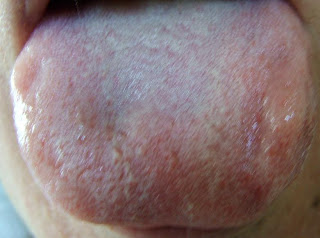
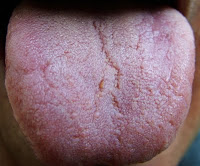
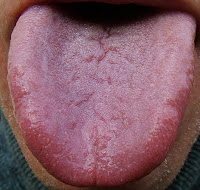
The following are three tongues that may be appropriate to this remedy. They are all swollen indicating Phlegm. The first is pale while the other two are red on the sides (indicating Liver-Yang rising).
Author: Giovanni Maciocia
Lingzhi slows progress of Alzheimer’s
28/04/2011
The legendary lingzhi mushroom has been shown to have another potential therapeutic function: to slow the progress of Alzheimer’s disease.
Lingzhi (Ganoderma lucidum), or reishi in Japanese, is a medicinal fungus used clinically in many Asian countries to promote health and longevity. 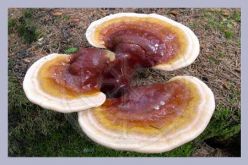
According to the researchers at the University of Hong Kong, synaptic degeneration is a key mode of neurodegeneration in Alzheimer’s disease. Recent studies have shown the loss of synaptic density proteins in each individual neuron during the progression of Alzheimer’s. It was recently reported that β-amyloid could cause synaptic dysfunction and contribute to Alzheimer’s pathology.
Alzheimer’s disease is a progressive neurodegenerative disease and the most common cause of dementia in the elderly. The neuropathology of Alzheimer’s is characterized at first by the deposition of extracellular amyloid plaques and intraneuronal neurofibrillary tangles in the brain, and later by the loss of neurons and their processes.
Alzheimer’s disease is expressed by excessive deposition of the β-amyloid peptide (β-AP) in the central nervous system. Cognitive impairment appears to be most closely correlated in time with the loss of neurons and neuronal processes.
In this study, the Hong Kong researchers reported that aqueous extract of lingzhi significantly attenuated Aβ-induced synaptotoxicity by preserving the synaptic density protein, synaptophysin.
What is synaptophysin? Synaptophysin is a synaptic vesicle glycoprotein with four transmembrane domains. It is present in neuroendocrine cells and in virtually all neurons in the brain and spinal cord that participate in synaptic transmission. It acts as a marker for neuroendocrine tumours.
Taken together, the results prove a hypothesis that anti-aging lingzhi can prevent harmful effects of the exterminating toxin Aβ in Alzheimer’s disease.
European Legislation for natural products
18/10/2010
European Legislation for natural products
Under the approval of the new European legislation that regulates manufacturing of all natural remedies it is possible that after next April we will see changes of prices for such products in all the stores.
E.Qi.Librium Herbs will try to minimize at maximum the increases in manufacturing prices in the retail price, but it is still early to know the exact details, what we guarantee to our customers is that we will continue making available all formulas that we have at the moment, though there might be changes at the level of labeling, manufacturer, price, etc., with the new rules only specially licensed manufacturers can produce and export their formulas. So there is no cause for alarm, we'll always put our efforts to better serve our customers.
700-year-old Chinese medicine can treat depression...
19/09/2010
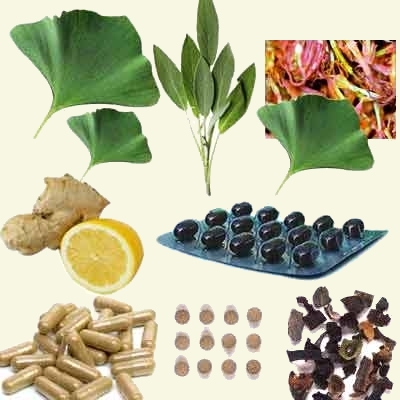
An ancient traditional Chinese medicine “wandering free - Jia Wei Xiao Yao” formula which is at least 700 years old has been proven scientifically to be effective in treating depression. The results of the study will be published in August.
Kami-shoyo-san (加味逍遙散, Jia Wei Xiao Yao San), a traditional Chinese medicine, has been used to treat patients with neuropsychiatric disorders. The Chinese term “xiao yao” means wandering free, which implies its anti-depressive effects.
What is Kamo-shoyo-san? Kami-shoyo-san consists of 10 medicinal herbs, including chai hu (柴胡, Radix Bulpleuri), bai shao (白芍, Radix Paeoniae), dang gui (當歸, Radix Angelicae Sinensis), and gan cao (甘草, Radix Glycyrrhizae), bo he (薄荷, Mentha haplocalyx), fu ling (茯苓, Poria cocos), mou dan pi (牡丹皮, Paeonia suffruticosa), 槴子 (Gardenia jasminoides), and ginger (Zingiber officinale). In Taiwan, its concentrated form was the most popular herbal drugfor depression and anxiety and alike disorders. It is also a popular herbal drug to treat insomnia in Japan.
The formula first appeared in Song Dynasty (between 960 and 1279 AD.) in a TCM classic He Ji Ju (太平惠民和劑局). It was said to relieve muscular pain, dizziness, uneasiness, hot flashes, extreme sweating, insomnia, decreasing appetite and abnormal menstrual symptoms. In modern times, it has been used to treat many neuropsychiatric disorders, as well as liver diseases.
Literature shows that the formula has been shown to relieve panic attacks, anticipatory anxiety and agoraphobia. It has been used to treat irregularity of menstruation and anxiety involved with a menstrual cycle.
When used as an adjunct to carbamazepine (carbamazepine is an anticonvulsant and mood stabilizing drug, used primarily in the treatment of epilepsy and bipolar disorder. It is also used to treat schizophrenia and trigeminal neuralgia) in patients with bipolar disorders, the Jia Wei Xiao Yao combo treatment resulted in significantly greater clinical response rate indepressed patients. Kamo-shoy-san has proved to provide additive beneficial effects in bipolar patients, particularly for those in the depressive phase.
A group of scientists at the Department of Neuropsychiatry, School of Medicine, Paik Inje Memorial Clinical Research Institute, Inje University, Korea conducted the study and its results will be published later this year in the medical journal Psychiatry and Clinical Neurosciences.
In the present study, the anti-depressant-like effects and mechanism of action were investigated. Male Sprague-Dawley rats were given 10-fold or 20-fold the typical human daily dosage. Immobility time was measured by the forced swimming test, and hippocampal neurogenesis was quantified under immobilization stress.
The results showed that rats given the 20-fold dosage had a significantly lower immobility time and improved neurogenesis in the hippocampus. However, no significant improvement was noticed on those that took the 10-fold dosage.
The researchers thus suggest that the Jia Wei Xiao Yao possesses an antidepressant-like effect at a behavioural and molecular level.
credits: chinese medicine news
Swine Flue
01/09/2009
How to prevent it trough Chinese Herbal Medicine
 What can you do to prevent or treat suspected Swine Flu? Using Chinese Medicine diagnostics, viral infections commonly fall into categories such as “Wind-Cold” invasion, “Wind-Heat” invasion, or “Heat-Toxins”. Various nutritional supplements and herbal formulas can be used to boost immune system activity and to remedy viral infections that manifest with these types of patterns.
* Increase intake of daily Vitamin D, Zinc, and Vitamin C.
* Yu Ping Feng San – This formula comes in many forms and with various herbs added, but the main herbs are Astragalus, Atractylodes and Siler, which, in combination, have been shown to increase immunoglobulins, macrophage activity, T-lymphocytes, Natural Killer cells and other immune actions. It is the main basic Immune System Tonic in Chinese Herbal Medicine and is traditionally used for people who get frequent colds, flus, and infections, and to increase energy and resistance. Constitutional Consideration: Best for prevention in people with a pale colored tongue.
Qing Qi Hua Tan Pian - formulated to treat primarily Lung-Heat at the Qi Level when the patient displays the following symptoms: cough, slight breathlessness, fever, feeling of heat, thirst, tightness of the chest and upper back. This formula has also a strong anti-viral action.
Symptoms of the Swine Flu are:
* sudden fever of greater than 38.5 degrees Celcius (100.4 degrees Farenheit)
* Cough
* Headache
* Aching Joints
* Nasal Congestion
* Chills
* General fatigue
* Diarrhea and/or vomiting
Diagnosis is made by sampling secretions from the inside of the nose and mouth during the first 24-72 hours of flu symptoms, or by testing blood samples for influenza virus presence.
Since the Swine Flu is spread by coughing, sneezing, or touching an infected person and then touching your own eyes, nose, or mouth, there are also simple actions you can take to prevent contracting or spreading the virus:
* Wash your hands frequently, especially after contact with infected individuals.
* Wear a mask, if you are in the presence of someone with the flu.
* Avoid kissing or shaking hands, sharing food, cuttlery, or glasses in households where someone may be infected.
* Ventilate your house well.
* Wipe door handles, telephones, salt and pepper shakers, and any other surfaces commonly touched by many members of your household, daily.
* Focus on getting proper rest and excercise.
-
-
Avoid excess sugar and alcohol; these lower your immune resistance drastically!
-