Cart is empty
Shop News
-
25/11/2025Ganoderma Benefits
-
07/02/2025Colds & Flu - treatment and prevention
-
24/01/2025Ginseng - Nature's anti-inflammatory
-
23/01/2025Curcumin Benefits
-
02/05/2024Allergies Tradicional Chinese Medicine
-
12/03/2024Food Combining and Chinese Medicine
-
23/08/2023Phytoestrogens
-
05/06/2023Ginseng Benefits
-
02/06/2023Aumento de precios de la marca Blue Poppy
-
20/07/2022Infertility and Chinese Medicine
-
10/05/2022Allergic Rhinitis
-
24/03/2022TCM Obesity and Its Causes
-
23/03/2022Cancer Prevention and Diet
-
26/01/2022Medicinal Mushrooms
-
18/12/2021Christmas Remedies
-
09/07/2021CANDIDIASIS
-
03/03/2021Chinese Herbal Medicine formula studied to improve cancer therapy
-
12/01/2021The benefits of Xiao Yao San
-
15/09/2020Coronavirus Protocol (summary)
-
01/06/2020TCM Principles for Weight Loss
-
12/02/2020Take Good Care of Your Qi
-
01/01/2020Cordyceps Sinensis Benefits
-
01/12/2019Prevention & Treatment of Colds & Flu
-
27/04/2019ANXIETY - causes and treatments
-
26/03/2019Prostatitis and Chinese Herbs
-
01/03/2019What is an Adaptogenic Herb?
-
05/02/2019New Jade Herbal Formulas
-
09/12/2018The Shen of the Heart
-
23/08/2018Hyperthyroidism and Hypothyroidism
-
05/07/2018FOCUS ON A REMEDY: WARM THE MENSES
-
04/04/2018Treating Insomnia With Chinese Herbal Medicine
-
25/03/2018Cordyceps Sinensis research
-
01/03/2018Chinese Herbal Medicine for Panic Attacks
-
07/11/2017BI SYNDROME
-
01/09/2017Chemotherapy and Anti-Oxidants
-
05/03/2017Lumbar Disc Herniation
-
31/01/2017Treatment Principles in Exterior Invasions
-
21/10/2016Healthy Aging and Oriental Medicine: Qi is the secret
-
23/09/2016Horny Goat's Weed Benefits
-
25/06/2016Ginkgo Biloba Benefits
-
23/03/2016Blood Stasis
-
23/01/2016CHRONIC FATIGUE SYNDROME
-
28/12/2015TONICS
-
24/10/2015A CASE HISTORY OF CHRONIC BRONCHITIS
-
23/09/2015Ganoderma Lucidum reduces obesity in mice
-
01/07/2015The Five Elements and Diet in Chinese Medicine
-
23/05/2015Daoist Sexual Practices
-
21/02/2015DEPRESSION
-
22/01/2015GLAUCOMA
-
20/12/2014ENDOMETRIOSIS
-
28/11/2014POLYCYSTIC OVARY SYNDROME
-
21/08/2014Ear infections and antibiotics
-
24/06/2014FOCUS ON A REMEDY: CHEMO-SUPPORT
-
21/03/2014Stomach-Yin Deficiency and Jade Spring
-
21/02/2014JOY, AN EMOTIONAL CAUSE OF DISEASE?
-
17/01/2014SEXUAL LIFE IN CHINESE MEDICINE
-
19/12/2013ON STAGNATION OF LUNG- AND HEART-QI
-
14/11/2013THREE TREASURES REMEDIES FOR PAIN
-
23/10/2013HEADACHE CASE HISTORY
-
12/07/2013Giovanni Maciocia Clinical Tip: Arouse Power
-
19/04/2013Case history - Chronic constipation
-
18/06/2012Herbs for the treatment of Anorexia
-
09/04/2012REMEDY OF THE MONTH: CLEAR YANG
-
28/04/2011Lingzhi slows progress of Alzheimer’s
-
18/10/2010European Legislation for natural products
-
19/09/2010700-year-old Chinese medicine can treat depression...
-
01/09/2009Swine Flue
Treatment Principles in Exterior Invasions
31/01/2017
I recently received an email from a colleague asking for a help with a patient suffering from chronic fatigue syndrome. The colleague was asking about the treatment principle to apply. The patient obviously suffered from a deficiency of Zheng Qi, as all patients with chronic fatigue syndrome do. But she also had frequent acute invasions of Wind. 
The colleague was rightly following the principle that, in the presence of an acute invasion of Wind, one must expel pathogenic factors, in this case expelling Wind, and not tonify Zheng Qi. In between invasions of Wind, the correct treatment principle is to tonify Zheng Qi, and this what the colleague was doing.
However, the problem was that the patient suffered from very frequent invasions of Wind, so that there was hardly any time to tonify Zheng Qi for a prolonged time. She was using Three Treasures remedies i.e. Expel Wind-Heat (a variation of Yin Qiao San) during the acute invasions of Wind and Herbal Sentinel to tonify Zheng Qi in between the acute attacks.
She wrote to me to ask whether taking Herbal Sentinel (i.e. a Qi tonic) during an acute invasion of Wind could strengthen the pathogen. She was also wondering whether one can go on taking Expel Wind-Heat for prolonged periods as the patient had times when she went from one acute illness to the next, so she could be taking Expel Wind-Heat for weeks, and my colleague was wondering whether this could deplete her Qi or Yin.
Her second question was whether taking Herbal Sentinel during an acute invasion of Wind could strengthen the pathogen.
I will try and answer here her questions.
1) Can one take a remedy that expels exterior Wind for prolonged periods?
The answer is basically: “no”. Remedies that expel exterior Wind (such as Expel Wind-Heat or Yin Qiao San) by definition should be taken only during an acute invasion of Wind for a few days. After a few days or a week, either the exterior Wind has been expelled or the pathogenic factor has penetrated into the Interior at which time the patient needs a different treatment.
However, chronic fatigue syndrome presents a different situation and one that is not contemplated in Chinese books. I have never seen a discussion of chronic fatigue syndrome in any Chinese book: indeed, a Chinese journal years ago published a translation of an article I wrote on chronic fatigue syndrome.
In my experience, chronic fatigue syndrome is characterized by a prolonged course of the disease with deficiency of Zheng Qi and frequent invasions of exterior Wind. However, the exterior pathogen in such patients is “weak” and it is weak precisely because of the prolonged course of the disease and the prolonged deficiency of Zheng Qi.
So, in such cases, the patient may need to take a remedy that expels exterior Wind frequently, e.g. for a week every few weeks or so. However, because the pathogen is weak, one can use a small dose such as for example only three tablets of Expel Wind-Heat a day.
2) Can tonifying the Zheng Qi also tonify an exterior pathogen?
Again, in theory “yes”. However, again, chronic fatigue syndrome is an exception. As the deficiency of Zheng Qi is very prolonged and the pathogen “weak”, during invasions of exterior Wind in chronic fatigue syndrome, I do occasionally combine expelling exterior Wind with Expel Wind-Heat (Yin Qiao San) with Herbal Sentinel, both in small doses. For example, I might use 3 tablets or Herbal Sentinel in the morning and 3 tablets of Expel Wind-Heat in the evening.
Note: Herbal Sentinel is a tonic of Lungs and Kidneys to strengthen Zheng Qi and prevent invasions of Wind. There are two variations of it: Herbal Sentinel-Yang for patient with a tendency to Yang deficiency and Herbal Sentinel-Yin for patients with a tendency to Yin deficiency
By Giovanni Maciocia
Healthy Aging and Oriental Medicine: Qi is the secret
21/10/2016
Healthy Aging and Oriental Medicine
Is there a limit to Qi energy reserves?
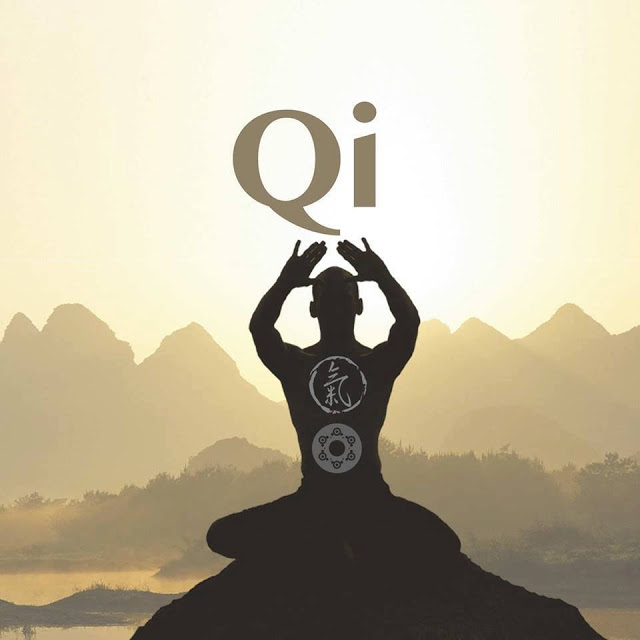
It is known in fundamental science, that the human form has a limited life span. This is true for most living species. What influences healthy aging of each living organism and especially the human form is unique to each individual based on common factors.
In Oriental Medicine, aging is viewed not by age but by the amount of Qi reserve within the complex of all body systems influenced by its environment.
In ancient times without the knowledge known now as the human genome, Eastern Medicine scholars viewed longevity by a relative quantity or manifestation of the amount of Vital Qi. Qi, known as an essential life giving force that permeates every cell, tissue, and organ, also is the trigger to signal a cell to thrive or die.
Inherited qi, also called Prenatal Qi, influences how much Qi a person is born with. Prenatal Qi is set by family genetic patterns and fetal health during prenatal life. These conditions vary from person to person and sets the stage for the quality and quantity of the Vital Qi someone is born with. It also influences the potential for good health throughout the course of one’s life.
If the Vital Qi could be measured, some would appear to be born with a full vessel filled with Qi while others may have only one half or two thirds full. If the amount of Qi in early life starts out less than full, it is more challenging to attain robust health and longevity. Although there are recommended suggestions to accelerate or try to catch up on Qi reserve, it is unlikely to reach the same full amount of vitality that some are naturally born with. In a more modern view, few inherent genetic markers can be self-corrected and therefore often impact the quality of long term health. Also known in modern medicine, is that by applying targeted nutritional intervention genetic errors can be redirected and improve outcomes and quality of health.
Preservation of Vital Qi
Factors that impact Vital Qi after childbirth initially have to do with neonatal and early childhood care and nutrition. As a child, Qi is more fragile and needs to be protected. Having a healthy environment emotionally, socially, and as well as nutritionally makes a difference. Exposure to medical interventions, drugs and toxins are best kept to a minimum since these impact the resilience of Qi. Early childhood nutrition builds the groundwork and sustains it in adult life for abundant Qi and blood to thrive.
Everyone is not the Same Constitution
In Eastern Medicine not everyone is expected to age the same way, not only because of the differences in Vital Qi levels or secondary to different genetics within an ethnicity, but because the body is viewed as different constitutional types. These different types pertain more to the laws of nature according to the elements. The five elemental constitutional types are water, wood, fire, earth and metal. Therefore health recommendations are individualized. Suggestions for someone who reflects a constitutional type pertaining more to the element of fire may not receive the same recommendations as one would if they reflected more qualities like the element of earth.
These element specific recommendations support nutrition and diet, exercise, sleep plus herbal formulas and acupuncture points. Those who reflect more of the element of fire would not benefit from spicy foods or a predominantly cooked food diet. Whereas those who reflect more of the earth element may benefit more from cooked pungent foods rather than cold and raw foods. Without personalized dietary choices, even a healthy diet may not build maximum Qi reserve.
Avoiding Excesses and Deficiencies
In order to avoid accelerating aging or damage to Vital Qi certain excesses and deficiencies are to be avoided. Excesses include too much exercise, sexual activity, medications and drugs, alcohol, extreme weather, internal and external toxins and excess emotions and stress. All of these in excess can cause damage to Vital Qi and prevent its consolidation.
Excess exposure to extreme climates can also be detrimental and cause imbalance even if it’s intended for sports and enjoyment. Some are more vulnerable to the outdoor elements and need more protection against overexposure. Wind is an element not well tolerated for those with a weak immune system. Any exercise in the wind is especially depleting.
Lifestyle can support the consolidation of Qi or it can accelerate its decline
Deficiencies that prevent the growth of Qi, include a lack of essential nutrients and food or not enough exercise, or adequate rest, relaxation, and a lack of human connection and affection. Without these vital life supportive qualities, Vital Qi is not nourished and can become depleted more easily.
Eastern medicine’s ancient knowledge shares secrets of increasing
Vital Qi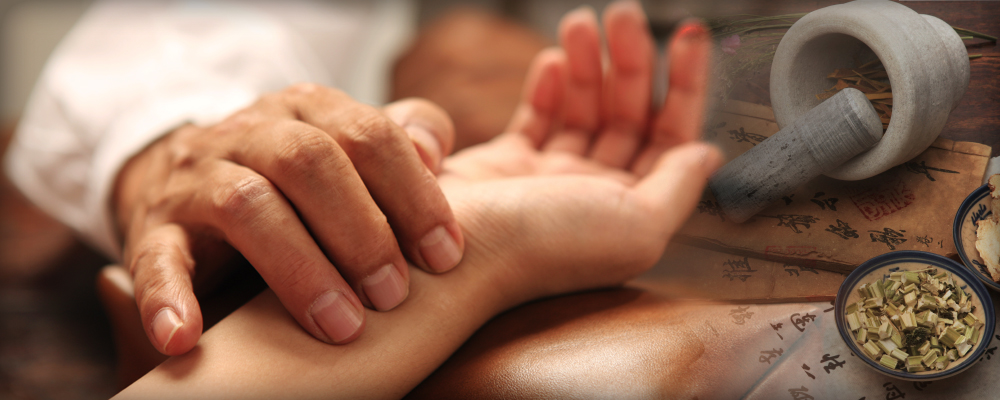
There are few super foods or vitamins that can increase Vital Qi. But with practice, vitality enhancing exercises like Qi gong, Tai chi, and yoga contribute to preserving and increasing Vital Qi. Ancient yogic breathing combined with movement helps to sustain vital functions and increase the abundance of Qi.
Herbs and Acupuncture
Adaptogenic Chinese herbal formulas are known to enhance Vital Qi and energy. Each formula is designed to adapt to the changes in Vital Qi as the body needs them. Many of these herbs contain active food constituents like bioflavonoids, and vitamins that improve immune function and support hormone activity. Examples of some of the common herbs recommended include shan yao (dioscorea), gou ji berries (lychi), rou cong rong (cistanches), various forms of ginseng, jiao gu lan (gynostemma), plus blood nurturing herbs like he shou wu (polygonum), dan shen (salvaiae), and dang gui (angelicae). (The herbs listed do not include a specific species)
Treatments with Acupuncture are selected based on individual constitutional type. Each point chosen taps into a network of circulating pathways that activate and recharge cellular activity. The beneficial effects serve as a way to consolidate reservoirs of energy stores and remove blockages of Qi that can slow down smooth active organ function. Receiving acupuncture on a routine basis is similar to getting an engine tune up at prescribed intervals to adjust and lubricate all its parts to keep all of its systems running smoothly.
Diet
Diet is known for its direct influence on health, and in Oriental medicine, food selection is also based on elemental constitutional type. There are five flavors that correspond with the five elements which include salty, sour, bitter, sweet, and pungent. Diets that are more individualized are more regenerative for each constitution and promote longevity as well as good digestive health.
Emotions
Balanced emotions can tip the scale between sustained health and depletion. Staying in harmony with one’s elemental constitution and life path helps keep emotions balanced and promotes sustained long-term health.
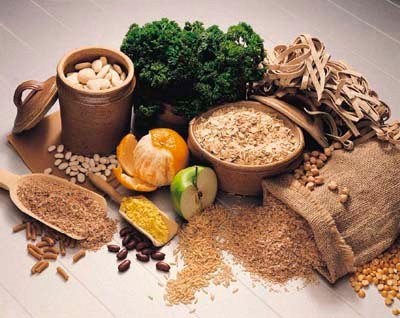
Optimal Health using Eastern Medicine
5 Vital Steps to Preserve Vital Qi and Longevity
1. Keep a diet diary and review the foods you crave the most.
Look at your diet and see which flavors you eat most often. The flavors you crave may indicate you need more of it in your diet to balance the five elements. It could also mean you are out of balance and what you crave is not beneficial for you. A good example is if you crave sweets. It doesn’t mean you are deficient in the flavor of sweet but may indicate a weak condition in the earth element or digestive system.
If you crave salt it could mean your water element, the kidney, is not concentrating your minerals well enough and you need the extra electrolytes derived from salt.
Himalayan salt from the east is known to be a powerful regulator of the body’s acid alkaline balance. It contains more than 80 minerals naturally without processing. It helps to regulate the brain’s neurotransmitter exchange, stabilizes bone growth and enhances the kidneys functions.
2. Eat according to your elemental constitution but include a balance of all 5 flavors in your diet.
Regardless of your elemental constitution, the digestive tract needs constant warmth to maintain the digestive fire. Digestion involves manufacturing enzymes and maintains a balance between good and bad bacteria. Include a balance between warm and cold foods to help regulate the digestive fire. An excess of either temperature will affect digestion and long term health.
Salty, sweet, sour, bitter, and pungent are common flavors to include in the diet. Bitter flavor is the least often included in the diet but is just as significant as the others. Foods like greens including kale, chard, arugula, broccoli, and green onions are bitter plus coffee, tea, and dark chocolate also have a bitter flavor. Eat these vegetables cooked and raw according to your constitution’s needs. Many herbal formulas use bitter herbs to balance the heart, digestion, and chronic infection conditions.
3. Exercise daily but gently. Begin the day with breathing exercises and add standing exercises like Qi Gong or Tai Chi plus moderate aerobic activity.
Standing Qi Gong strengthens the tendons, ligaments, and joints. It strengthens the Vital Qi to connect the mind and body. It opens up the acupuncture channels and cultivates yang qi to reinforce natural body detoxification and consolidates yin qi to nourish blood and beneficial fluids. It harmonizes internal organs to support the transformation of physical energy into vital sustainable energy.
One common Qi Gong exercise is standing with the feet shoulder distance apart knees slightly bent with the elbows bent and hands positioned as if holding a large imaginary ball. Take steady deep breaths while lightly applying pulsed pressure on the imaginary ball and releasing with each exhale. Practice for 5 -10 minutes daily which will gradually strengthen and enhance continuous sustainable energy.
4. Balanced emotions Self-reflection
Keeping balanced emotions requires time for contemplation and self-reflection. Allow enough quiet time to listen to your internal voice. Stay in touch with what your body may tell you it needs. A time for meditation is best in between meals. Flavors you crave may become more obvious at this time. Thoughts and good ideas may become clearer by allowing this time for them to come quietly into your inner sanctum. After 20 minutes of contemplation without distractions, feelings may surface and can be processed while with a restful mind. Without including this part of health maintenance, imbalanced emotions often lead to stress and excess strain on the body’s balancing systems.
5. Sleep and Self Massage
Sleep is essential to keep the “Shen” or spirit balanced. Without enough sleep Vital Qi cannot regenerate. Over time lack of sleep can create an excess of stress and demand on the body, mind, and spirit.
Create restful rituals before bedtime. Allow 30 minutes before bed to create a quiet and restful environment. Self-massage helps to relieve tension and relax muscles and nerves. Use a long handled massage tool to stroke across the upper back and shoulders. Using mild pressure press along the acupressure channels on both sides of the forearm. Using the fingertips press acupuncture points surrounding the ears and across the forehead. Finally, stroke downward from the scalp to the face several times closing the eyes just before the final moments before sleep.
Take long deep breaths as a way to invite the body to drift into a peaceful sleep.
Horny Goat's Weed Benefits
23/09/2016
Horny Goat's Weed Benefits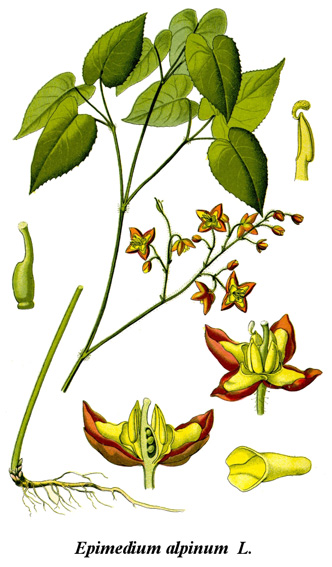
Horny Goat Weed are from the species (Epimedium). Epimedium is a genus of 63 species of flowering plants in the family Berberidaceae. Legend in China claims that this weed was ingested by some goats. The herder observed the behavior of the animals after consuming the plant and decided that this plant must contain certain properties associated with aphrodisiacs. After many hundreds of years of use, the specific properties of the plant were identified and their methods of action better understood.
Common names
Epimedium, also known as barrenwort, bishop's hat, fairy wings, horny goat weed, rowdy lamb herb, randy beef grass or yin yang huo
Active Ingredients
One of the principal active ingredients in Horny Goats weed is "icariin". The concentration may determine much of the potency of each particular species of Epimedium. The icariin works by relaxing smooth muscle tissue, which is different from skeletal muscle tissue. The significance of this is that involuntary tension in the internal tissues can be relaxed, which many believe cause the central nervous system to shift from the so-called fight/flight mode into the rest/restore mode. When this change occurs, many elements of a disease tend to reverse because the body is no longer in a stressed condition. Although this may not cure many problems, especially the ones that are in advanced stages, many people use herbs to manage their condition and obtain some relief.
Habitat
Horny Goat Weed is found growing all over the southern areas of China, but can also be found in the Asian countries that immediately border China, as well as some neighboring European countries. The Chinese name is Yin Yang Huo, or Xian Ling Pi, and it is used extensively in Traditional Chinese Medicine (TCM). It has become popular in the field of Western alternative medicine for use in treating multiple conditions.
One should realize that although the plant may bear the same name, there are close to 60 species of Epimedium plants and over 15 in China that bears the name "Yin Yang Huo." It might be difficult for the layperson to determine the strength and properties of the plant based on the name alone.
 Benefits and Conditions
Horny Goat Weed is often used to treat osteoporosis and various sexual dysfunctions. However, other uses of the plant include the treatment of hypertension, bronchitis, coronary heart disease, polio and more. This makes sense because the active ingredient works on smooth muscle tissue. Theese are the tissues that surround the heart. When the heart muscles are under strain, it is easy to visualize how this can cause other problems in the surrounding affected systems.
Secondary benefits can also occur when the smooth muscle tissues relax. The health benefits could extend to relieving fatigue in both the mind and the body, as this herb is employed for this purpose in TCM. It has been used to treat joint pain, numbness, memory problems, painful or cold low back and/or knees, as well as irregular menstrual cycles, spermatorrhea, and impotence. It has been cited as producing an anti-aging effect and can improve the immune system as well as the endocrine system.
Ginkgo Biloba Benefits
25/06/2016
Ginkgo Biloba, 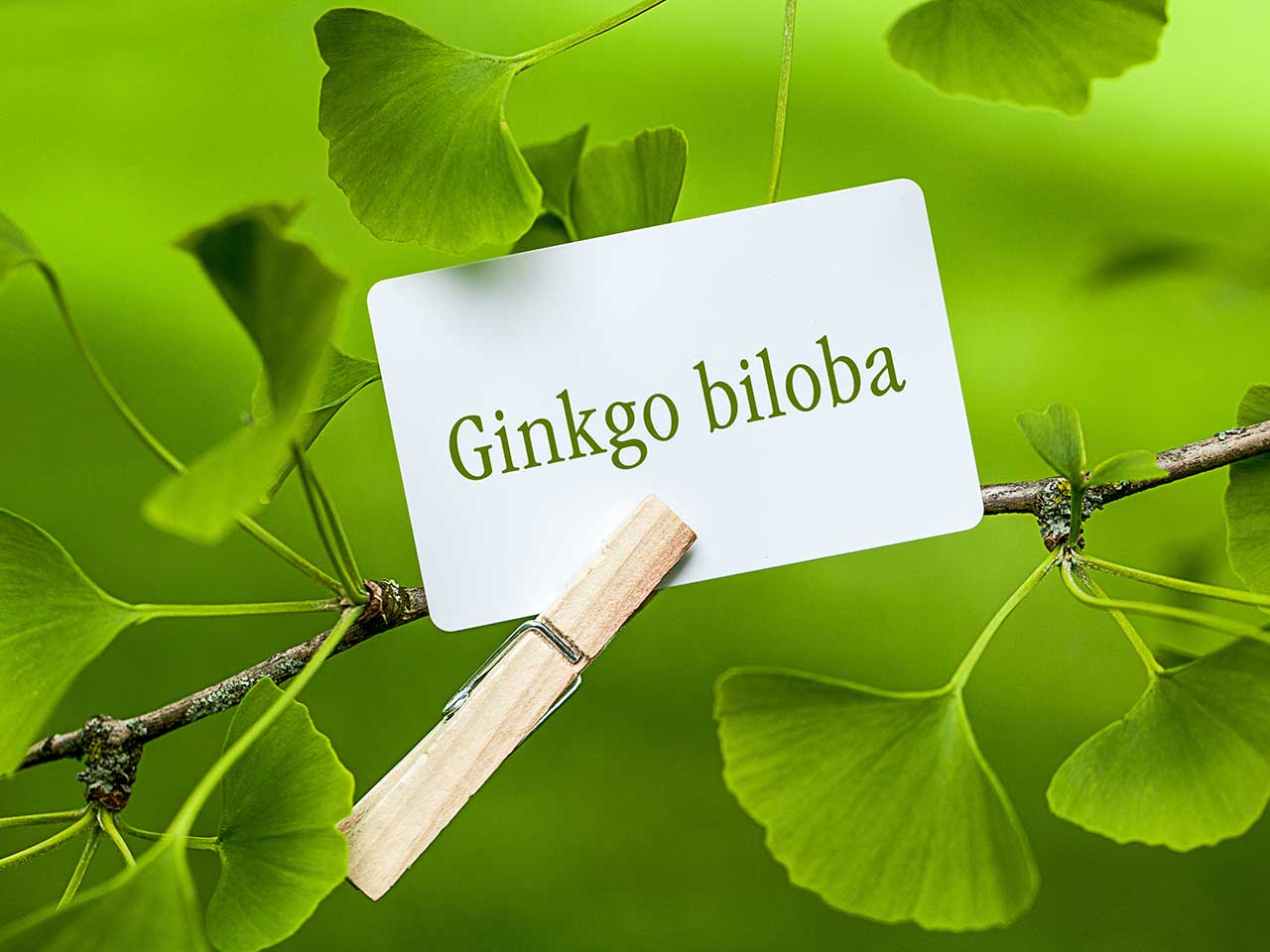 also known as Maidenhair, has been traced back nearly 300 million years making it the oldest surviving tree species on earth! The Chinese have used the plant medicinally for eons but many of the modern applications come from the research of German scientists. Ginkgo is a prescription herb in Germany.
Ginkgo Biloba is especially good when combined with Panax Ginseng.
Ginkgo Biloba extract has proven benefits to elderly persons. This ancient herb acts to enhance oxygen utilization and thus improves memory, concentration, and other mental faculties. The herbal extract has also been shown to significantly improve long-distance vision and may reverse damage to the retina of the eye. Studies have also confirmed its value in the treatment of depression in elderly persons. The ginkgo extract may provide relief for persons with headache, sinusitis, and vertigo. It may also help relieve chronic ringing in the ears known as tinnitus.
In studies, Ginkgo Biloba has been reported as demonstrating anti-oxidant abilities with improvements of the platelet and nerve cell functions and blood flow to the nervous system and brain. It has also been reported as reducing blood viscosity. It's ability to increase vascular dilation, may help reduce retinal damage due to macular degradation and may reverse deafness caused by reduced blood flow.
Recently, extensive research on the herb has been conducted on the healing properties of the leaf extract. Germany and France have run literally hundreds of studies on the leaf extract. These studies along with similar studies in America, have shown significant results. The extract of Ginkgo Biloba has been studied for its effectiveness in the treatment of Acrocyanosis, Alzheimer's disease, Cerebral atherosclerosis, Cerebral insufficiencies, Cochlear deafness, Dementia, Depression, Menopause, Peripheral and cerebral circulatory stimulation, Peripheral vascular disease, Raynaud's syndrome, Retinopathy, Senility, Short-term memory loss, Tinnitus, Vascular Diseases, and Vertigo.
It is said to be effective in improving the blood flow to the hands and the feet as well as stimulating the brain and reducing short-term memory loss. It increases blood flow to the brain, the uptake of glucose by brain cells, and has been said to improve the transmission of nerve signals.
Depression
Patients suffering from varying degrees of vascular insufficiency also noted an improvement in mood while taking Ginkgo Biloba extract. This has prompted a surge of interest in its use as a treatment for depression, especially in the elderly. Many people have found Ginkgo Biloba to enhance other depression treatments and to often even prevent the need for pharmaceutical treatments in mild cases of depression. Those under the age of fifty may also benefit from ginkgo biloba's antidepressant effects. So far though, the greatest level of improvement has been noted with older patients.
Alzheimer's & Mental Function
As more than 300 studies demonstrate, Ginkgo Biloba facilitates better blood flow through out the body, most notably the brain, where it both protects and promotes memory and mental function, even for people with Alzheimer's disease. It also offers a wealth of possibilities in the treatment of many other common ailments.
Alzheimer's
Since doctors are still not sure what causes Alzheimer's disease, we do not have a definite idea of how Ginkgo Biloba works to stabilise, and in some cases, improve the quality of life for those suffering from this degenerative disease. Scientists have noted that Alzheimer's is marked by a major loss of nerve cells in the brain, particularly those in areas controlling memory and thinking. Since doctors have found antioxidants to help slow the destruction of nerves, it is not a stretch to see ginkgo's antioxidant properties helping in this area. The disease is also believed to have a connection to decreased blood flow to the brain. If so, ginkgo's vasodilating effects may be a big help in the treatment process. Either way, prominent doctors and scientists believe ginkgo to be the supplement of choice to help hold off and possibly treat Alzheimer's.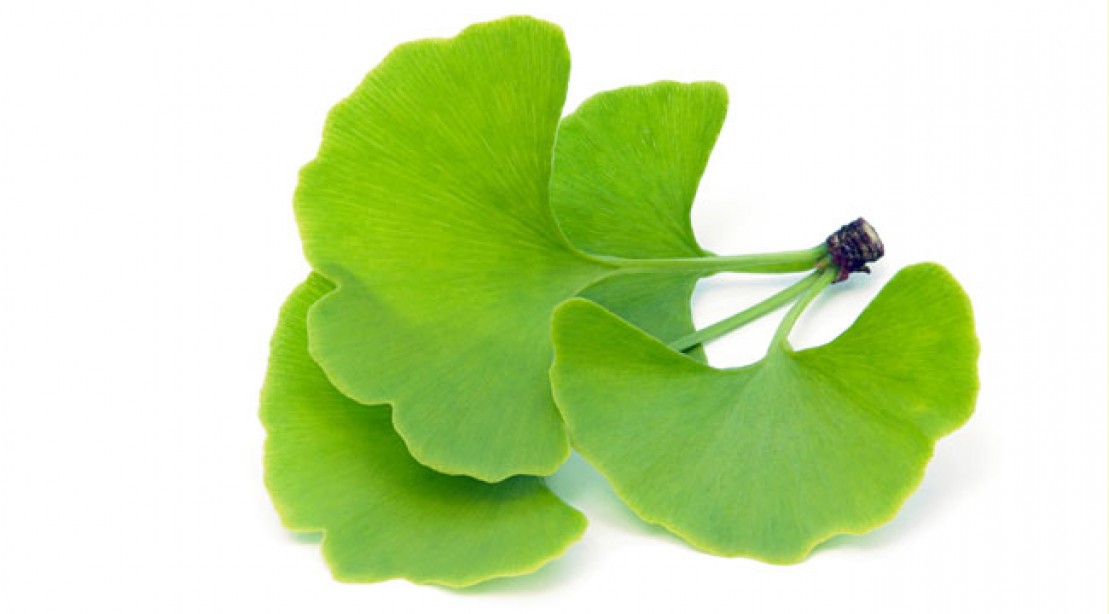 Antioxidant Properties
Although oxygen is essential for life, it can have adverse effects on your body. Unstable oxygen molecules can often be created during our body's normal break down and use of oxygen or can form in response to external factors and pollutants. These unstable molecules, called free radicals, can damage cells and structures within cells. If the genetic material in cells is affected and not repaired, it can replicate in new cells, contributing to cancer and other health problems. These free radicals may also weaken artery walls, allowing fatty deposits that can lead to hear disease. As an antioxidant, ginkgo biloba combats free radicals and repairs molecular damage. A great deal of research suggests that antioxidants such as Ginkgo Biloba may play important roles in preventing or delaying heart disease, cancer and other ills. Antioxidants may even halt the damage to cells, thereby slowing the effects of aging.
Impotency
Another use for Ginkgo Biloba is in the treatment of impotency. The main cause of male impotence is poor circulation and impaired blood flow through the penis, which is often the result of atherosclerosis. Since ginkgo biloba increases blood flow, it's been found to help up to fifty percent of patients after six months of use.
Raynaud's disease
Raynaud's disease is believed to be caused by blood vessels that over react to the cold and spasm, reducing blood flow and there by depriving extremities of oxygen. Ginkgo Biloba may help this condition by widening the small blood vessels, which would keep these spasms from completely blocking the blood flow.
Parkinson's Disease
The lack of dopamine is believed to produce the progressive stiffness, shaking and loss of muscle coordination typical in Parkinson's disease. Doctor's theorise that along with other treatments, Ginkgo Biloba may help symptoms by increasing the brain's blood flow and thereby allowing more of the depleted dopamine to be circulated to the areas that need it most.
Other Conditions
Other uses for which Ginkgo Biloba extract is often recommended include depression, diabetes related nerve damage and poor circulation, allergies, vertigo, short-term memory loss, headache, atherosclerosis, tinnitus, cochlear deafness, macular degeneration, diabetic retinopathy, and PMS.
Strokes
Scientists continue to study the prevention and treatment benefits to stroke patients that are attributed to Ginkgo Biloba. It's believed that by preventing blood clots from developing and increasing the blood flow to the brain, ginkgo biloba may help stop strokes from occurring. It's also believed that the herb inhibits free-radical damage of brain cells after a stroke.
Latin Names
Ginkgo biloba, Salisburia adiantifolia, Salisburia macrophylla
Common Names
Bai Guo, Ginkgo Nut, Japanese Silver Apricot, Kew Tree, Maidenhair Tree, Yinhsing
Properties.jpg "Ginkgo Biloba")
Antiinflamatorio, antioxidante, mejora el flujo sanguíneo, fortalece los vasos sanguíneos, relaja los pulmones, tónico del sistema circulatorio, vasodilatador
Indicado para:
Anti-inflammatory, Antioxidant, Improves blood flow, Strengthens blood vessels, Relaxes the lungs, circulatory system tonic, vasodilator
Indicated for:
Acrocyanosis, allergies, Alzheimer's & Mental Function, asthma, cerebral atherosclerosis and/or insufficiencies, cochlear deafness, cramp from walking, dementia, depression, diabetes related nerve damage and poor circulation, diabetic retinopathy, erectile function, headaches, impotency, improving circulation to the brain in the elderly, improving deafness, improving long-distance vision and possibly reversing damage to the retina, intermittent claudication, leg ulcers, macular degeneration, menopause, multiple sclerosis, Parkinson's Disease, peripheral and cerebral circulatory stimulation, peripheral vascular disease, PMS, poor circulation, Raynaud's disease, senile dementia, short-term memory loss, sinusitis, strengthening memory, strokes, tender or painful breasts, thrombosis, tinnitus, varicose veins, vertigo, white finger and spontaneous bruising.
Ginkgo Biloba can interfere with platelet aggregation and, as such, individuals taking anti-coagulants (blood thinners) or antithrombotic medicines, should seek professional guidance.
Individuals who take medications to prevent seizures and individuals who have ever had a seizure should avoid taking ginkgo.
Ginkgo should be avoided two days before and one to two weeks after surgery to avoid bleeding complications.
Ginkgo is not recommended during pregnancy, breast-feeding, or early childhood.
Blood Stasis
23/03/2016
Blood stasis is a common and damaging pathogenic factor that is at the root of many serious diseases. A characteristic of Blood stasis is that it can only occur after a prolonged period of time: thus, it is always a relatively serious pathogenic factors and one that leads to more serious diseases than Qi stagnation: for example, coronary heart disease, abdominal masses, tumours, high blood pressure, stroke, etc. By definition, Qi stagnation cannot, by itself, cause any of the above problems. Thus, whenever we see signs of Blood stasis, we know that the condition is one of long duration and the prognosis is less good than that for Qi stagnation.
1. AETIOLOGY
Blood stasis never arises independently (like Qi stagnation) but is always the consequence of other conditions, usually after a long period of time. Thus, there are no aetiological factors (diet, emotions, etc.) that give rise to Blood stasis by themselves as Blood stasis itself arises from other conditions. The conditions giving rise to Blood stasis are as follows:
Qi stagnation - LIV - HE
Internal Cold - Uterus - ST - HE
Heat or Fire - ST - INT - HE - LIV - UT
Qi deficiency - ST - HE
Blood deficiency - Uterus - HE, LIV
Phlegm - ST - INT - Uterus
2. PATHOLOGY
Blood is related to Qi and to Body Fluids. It is related to Qi first of all because Blood itself is a (very dense) form of Qi and secondly because it relies on Qi for its movement. "Qi is the commander of Blood; when Qi moves, Blood moves. Blood is the mother of Qi; where Blood goes, Qi goes". On the other hand, Blood is part of Body Fluids and is formed from them (with the participation of Gu Qi). Thus, both Qi and Body Fluids pathology may play a role in Blood stasis. For example, Qi stagnation is a very common cause of Blood stasis, while a pathology of the Body Fluids, such as Phlegm, may also lead to Blood stasis. Another pathology of Body Fluids leading to Blood stasis occurs when Heat or Fire condense the Body Fluids and make the blood more dense, leading to Blood stasis. We can review the pathology of the various causes of Blood stasis.
1) Qi stagnation
Qi is the commander of Blood and Blood relies on the pushing action of Qi for its movement; any Qi stagnation may lead to Blood stasis after some time.
2) Internal Cold
Both Full Cold and Empty Cold obstruct the movement of Qi and Yang and may lead to Blood stasis; this also occurs because Cold congeals Blood.
3) Heat or Fire
Heat or Fire injure and condense the body fluids and therefore Blood since Blood is part of body fluids. This may occur in the Heart, Liver, Stomach, Lungs, Intestines and Uterus.
4) Qi deficiency
Qi deficiency may lead to Blood stasis because deficient Qi fails to move and transport and may lead to Qi stagnation and Blood stasis.
5) Blood deficiency
Blood deficiency may also lead to Blood stasis because Blood is the mother of Qi, when Blood is deficient, Qi is also usually deficient, Qi fails to move Blood and Blood stasis ensues. A simultaneous Blood deficiency and stasis is more common in women.
6) Phlegm
There is a strong interaction between Phlegm and Blood stasis as both are pathologies of Body Fluids. Phlegm is a pathological accumulation of turbid fluids, while Blood stasis is a pathological accumulation of Blood; since there is an interchange between Blood and Body Fluids, Blood stasis and Phlegm interact with each other and aggravate each other. A simultaneous condition of Blood stasis and Phlegm is common in the elderly and it is a particular pernicious combination leading to serious diseases which are difficult to treat.
The first three aetiological factors are the most important ones.
CONSEQUENCES OF BLOOD STASIS
Blood stasis can itself become a cause of disease. The four consequences of Blood stasis may be:
Blood deficiency
Bleeding
Dryness
Qi deficiency
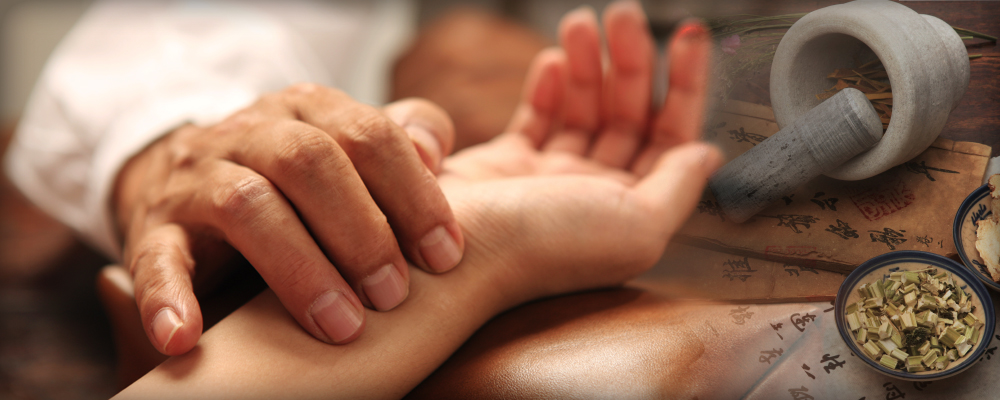 3. DIAGNOSIS
The main manifestations of Blood stasis are:
Pain
Swellings, lumps, tumours, masses
Colour purple
Purple tongue
Dark complexion
Dry nails and hair
Bleeding
Maculae
Stiffness
Dreaming a lot
Poor memory
Dark moles
Dark eye sockets
Purple nose bridge
Purple venules visible under the skin, often on the legs
Umbilicus bulging out
Hardness of the abdomen on palpation
Enlarged ends of fingers and toes
Skin not elastic, lustreless, dark, scaly, dry
A history of chronic illness with repeated bouts
Adhesions and scars from surgery
Poor memory
Pulse. The pulse indicating Blood stasis may be Wiry, Firm or Choppy
Irregular periods, painful periods with dark clots, hesitant start to periods, periods starting and stopping, infertility
Fever (sometimes)
Mental restlessness
Thirst with desire to gargle but not to swallow
Abdominal pain
4. TREATMENT PRINCIPLES AND METHODS
a) BEN-BIAO and XU-SHI
Blood stasis is always the Manifestation (Biao) of a condition because it arises from other conditions such as Qi stagnation, Cold, Heat, etc. Blood stasis is a Full condition by definition. Thus, the question arises how to approach a patient who suffers from Blood stasis (Full-Biao) but also from an underlying condition that is the Ben (which, itself, may be Xu or Shi).
The Ben of Blood stasis may be a Deficiency (of Qi or Blood) or a Fullness (Cold, Heat or Phlegm). Thus, treating Ben consists in either tonifying Qi and Blood or in scattering Cold, clearing Heat or resolving Phlegm. Since Blood stasis is always a chronic condition, generally speaking one needs to treat both Ben and Biao simultaneously. However, especially when herbal medicine is used, the question arises whether one should start with a formula to invigorate Blood modifying it to treat the Ben, or start with a formula to treat the Ben modifying it to invigorate Blood. The answer is simple: in more acute cases when the symptoms and signs of Blood stasis predominate, start with a modification of a formula to invigorate Blood and eliminate stasis; in more chronic cases when the symptoms and signs of Blood stasis are less pronounced, start with a modification of a formula that treats Ben. My personal inclination, however, is always to clear pathogenic factors first, i.e. in the case, invigorate Blood and eliminate stasis.
5. THREE TREASURES REMEDIES FOR BLOOD STASIS
STIR FIELD OF ELIXIR
This is a variation of Ge Xia Zhu Yu Tang Eliminating Stasis Below the Diaphragm Decoction. It is used for Blood stasis in the Lower Burner. This is very common in women. It may therefore be used for painful periods from Blood stasis.
INVIGORATE BLOOD AND STEM THE FLOW
This is a very useful remedy in gynaecological conditions. It simultaneously invigorate Blood and stops bleeding. This action is very useful as bleeding from Blood stasis is a common occurrence in gynaecological conditions. For example, this occurs frequently in endometriosis when the periods are very painful and the menstrual blood has dark clots (Blood stasis) but the periods are also heavy. Paradoxically, Blood stasis may aggravate heavy bleeding as the stagnant blood obstructs the uterus so that new blood has nowhere to go and leaks out. In all these cases, the remedy Invigorate Blood and Stem the Flow is very useful.. It is best used in phases 4 and 1.
HARMONIZING THE MOON
This remedy is specific for endometriosis. It not only invigorate Blood but it also "breaks" Blood and dissolves masses. It is used for endometriosis because the endometriosis lesions are considered a form of Abdominal Masses (zheng jia) from Blood stasis.
CLEAR THE ROOT
Clear the Root is not specific for Blood stasis as it also resolves Phlegm and Dampness and clears Heat. However, it also invigorates Blood in the prostate.
By Giovanni Maciocia
More Blood Stasis Formulas:
XUE FU ZHU YU TANG (Indications: Cardiovascular disorders, such as coronary artery disease (CAD), angina pectoris, and rheumatic heart disease, chondrocostritis, external injury to the chest, and various psychiatric disorders, such as mood disorders, sleep disorders, palpitations, anxiety, agitation, insomnia, a feeling of anxiety at bedtime, irritability, mental confusion, depression, postconcussion syndrome, chronic stabbing headaches, etc.)
FU FANG DAN SHEN PIAN (Indications: heart disease, endocarditis, myocarditis, angina pectoris, bruising and pain of traumatic origin, fixed pain, persistent, severe, acute, sometimes worse at night, and that radiates to the left arm (myocardial infarct) hypertension, palpitations.)
CHRONIC FATIGUE SYNDROME
23/01/2016
 I recently received an email from a colleague asking for a help with a patient suffering from chronic fatigue syndrome. The colleague was asking about the treatment principle to apply. The patient obviously suffered from a deficiency of Zheng Qi, as all patients with chronic fatigue syndrome do. But she also had frequent acute invasions of Wind.
The colleague was rightly following the principle that, in the presence of an acute invasion of Wind, one must expel pathogenic factors, in this case expelling Wind, and not tonify Zheng Qi. In between invasions of Wind, the correct treatment principle is to tonify Zheng Qi, and this what the colleague was doing.
However, the problem was that the patient suffered from very frequent invasions of Wind, so that there was hardly any time to tonify Zheng Qi for a prolonged time. She was using Three Treasures remedies i.e. Expel Wind-Heat (a variation of Yin Qiao San) during the acute invasions of Wind and Herbal Sentinel to tonify Zheng Qi in between the acute attacks.
She wrote to me to ask whether taking Herbal Sentinel (i.e. a Qi tonic) during an acute invasion of Wind could strengthen the pathogen. She was also wondering whether one can go on taking Expel Wind-Heat for prolonged periods as the patient had times when she went from one acute illness to the next, so she could be taking Expel Wind-Heat for weeks, and my colleague was wondering whether this could deplete her Qi or Yin.
Her second question was whether taking Herbal Sentinel during an acute invasion of Wind could strengthen the pathogen.
I will try and answer here her questions.
1) Can one take a remedy that expels exterior Wind for prolonged periods?
The answer is basically: "no". Remedies that expel exterior Wind (such as Expel Wind-Heat or Yin Qiao San) by definition should be taken only during an acute invasion of Wind for a few days. After a few days or a week, either the exterior Wind has been expelled or the pathogenic factor has penetrated into the Interior at which time the patient needs a different treatment.
However, chronic fatigue syndrome presents a different situation and one that is not contemplated in Chinese books. I have never seen a discussion of chronic fatigue syndrome in any Chinese book: indeed, a Chinese journal years ago published a translation of an article I wrote on chronic fatigue syndrome. In my experience, chronic fatigue syndrome is characterized by a prolonged course of the disease with deficiency of Zheng Qi and frequent invasions of exterior Wind. However, the exterior pathogen in such patients is "weak" and it is weak precisely because of the prolonged course of the disease and the prolonged deficiency of Zheng Qi.
So, in such cases, the patient may need to take a remedy that expels exterior Wind frequently, e.g. for a week every few weeks or so. However, because the pathogen is weak, one can use a small dose such as for example only three tablets of Expel Wind-Hea a day.
2) Can tonifying the Zheng Qi also tonify an exterior pathogen?
Again, in theory "yes". However, again, chronic fatigue syndrome is an exception. As the deficiency of Zheng Qi is very prolonged and the pathogen "weak", during invasions of exterior Wind in chronic fatigue syndrome, I do occasionally combine expelling exterior Wind with Expel Wind-Heat (Yin Qiao San) with tonifying Qi with Herbal Sentinel, both in small doses. For example, I might use 3 tablets or Herbal Sentinel in the morning and 3 tablets of Expel Wind-Hea in the evening.
Note: Herbal Sentinel is a tonic of Lungs and Kidneys to strengthen Zheng Qi and prevent invasions of Wind. There are two variations of it: Herbal Sentinel-Yang for patient with a tendency to Yang deficiency and Herbal Sentinel-Yin for patients with a tendency to Yin deficiency.
By: Giovanni Maciocia
TONICS
28/12/2015
TO TONIFY OR TO EXPEL: THAT IS THE QUESTION
Since the beginning of the history of Chinese herbal medicine, there has been an ongoing debate between different schools of thought as to whether one should tonify or expel.  Lui Wan Su (1110-1200), a chief exponent of the School of Cooling, emphasized the necessity of clearing Heat and Fire. Zhu Dan Xi (1281-1358) said that nourishing Yin is the most crucial treatment principle because Yin is depleted by overwork. The School of Eliminating Pathogenic Factors, led by Chang Cong Cheng (1156-1228) advocated vomiting, sweating, purgation and even inducing salivation, sneezing and lachrymation as a way of expelling pathogenic factors, in his view the cause of most pathologies. Li Dong Yuan, the author of the celebrated “Discussion on Stomach and Spleen” (Pi Wei Lun) said that most diseases are caused by a deficiency of Stomach and Spleen induced by overwork and irregular diet and therefore advocated tonifying the Stomach and Spleen as the most important treatment method.
Therefore, it is important to be aware that there is no “set answer” as to when to tonify and when to expel and that one must examine each individual case and come to a decision based on the symptoms and signs of that patient using our own knowledge and judgement.
EMPTY CONDITIONS
Tonics are obviously applicable when a patient suffers from a predominantly Empty condition, manifesting with a deficiency of either Qi, Blood, Yin or Yang, or a combination of any of these. It is important always to bear in mind that we must diagnose whether a condition is Full or Empty mainly from taking the pulse and observing the tongue. For example, a 50-year-old man may complain of tiredness, depression and exhaustion but, on taking his pulse, we find it is Full and Wiry. Therefore we can deduce that his symptoms derive from a Full rather than an Empty condition and it would not be applicable to tonify either with acupuncture or herbs.  CAUSES OF DISEASE IN EMPTY CONDITIONS
As mentioned above, some schools of thought believe that, theoretically, we should never need to prescribe herbal tonics if we ate a proper diet and balanced work and rest in a good way. So this implies that, even eight or nine hundred years ago, humans had a tendency to work too hard, not rest and not eat a good diet, rather than this being a purely 21st century phenomenon! Today, of course, few people live in a way which is health-enhancing and therefore it is often necessary to tonify with herbal medicine. The following are the most commonly seen factors which deplete a patient's energy
1. Poor diet: our post-natal Qi is mostly affected by what we eat. Eating on the go and eating the wrong foods weaken our Qi. A striving to be "fashionably thin", causing patient's to eat too little or follow fad diets generally leads to a deficiency of Qi and Blood. Patients who have been vegetarian for a long time and have not included good quality protein in their diet often present with severe Blood or Yin deficiency.
2. Overwork: working long hours and always being on the go depletes our Yin energy. This view was proposed by Zhu Dan Xi (a chief exponent of the School of Yin-Nourishing) in the 14th century and still very much applies to our society today. Many patients leave home at 6am and return at 10pm and expect not to be physically effected by this. Excessive mental work depletes Spleen-Qi and eventually Spleen-Blood. This is commonly seen in practice in students who are studying long hours or those in professions where a lot of mental work is needed.
3. Emotions: over-thinking and worry deplete Spleen-Qi and Blood. Fear depletes Kidney-Yin and/or -Yang. Grief and sadness deplete Lung-Qi. All these emotions, as well as many others, are widespread in today’s society.
4. Excessive sexual activity: injures the Kidneys, especially Kidney-Yin (more in men than in women).
5. Miscellaneous: there are many other "habits" of the Western world today which are severely depleting. For example, women who work hard throughout their pregnancy and go back to work soon after the baby is born will often develop Kidney deficiency and Blood deficiency; excessive exercise, done in the name of "keeping fit" (especially running) consumes our Yang energy.
YANG TONICS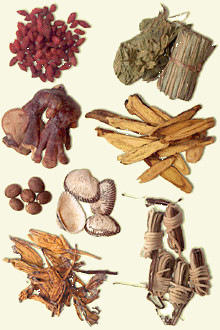
Strengthen the Root
Pattern: Kidney-Yang deficiency, Fire of the Gate of Vitality declining, slight Blood deficiency
Action: Tonify and warm Kidney-Yang, stoke up the Fire of the Gate of Vitality, fill the Essence, nourish Blood, strengthen the Will-Power
Indications: Chilliness, cold feet, cold limbs, lower backache, weak knees, dizziness, tinnitus, depression, exhaustion, impotence, lack of libido, loose stools, pale urination, oedema, lack of drive
Tongue: Pale, Wet
Pulse: Deep-Weak
Unicorn Pearl
Pattern: Kidney-Yang deficiency, Essence deficiency
Action: Tonify and warm Kidney-Yang, nourish the Essence, strengthen the Governing, Directing and Penetrating vessels
Indications: Infertility, backache, dizziness, tinnitus, feeling cold, a history of amenorrhoea, or scanty periods, irregular periods, frequent pale urination, tiredness, depression, a history of miscarriages, pale complexion.
Tongue: Pale, wet
Pulse: Deep, weak
Strengthen the Root is a general Kidney-Yang tonic which may be used for men or women.
Unicorn Pearl is also Kidney-Yang tonic but is specifically for women with gynaecological problems deriving from Yang deficiency.
YIN TONICS
Nourish the Root
Pattern: Kidney-Yin deficiency
Action: Nourish Kidney-Yin and Essence, strengthen the will-power
Indications: Dizziness, tinnitus, sore back and legs, night-sweating, dry mouth and throat in the evening, feeling of heat, 5-palm heat, thirst, lower backache, depression, scanty-dark urine, dry skin and hair, dry stools.
Tongue: Red with rootless coating or no coating
Pulse: Floating-Empty or Weak on both rear positions.
Central Mansion and Prosperous Earth are similar remedies; however, Central Mansion is applicable when the patient has Qi deficiency with some Dampness but also tends towards Yin deficiency. Prosperous Earth, on the other hand, treats solely Qi deficiency.BLOOD TONICS
Precious Sea
Pattern: Qi and Blood deficiency, Kidney deficiency
Action: Tonify Qi, nourish Blood, tonify the Kidneys
Indications: Tiredness, debility, weariness, depression, loose stools, poor appetite, blurred vision, tingling of limbs, insomnia, poor memory, dizziness, scanty periods or heavy periods, amenorrhoea, irregular periods, pale complexion, palpitations, backache, low libido, infertility.
Brighten the Eyes
Pattern: Deficient Liver-Blood and Kidneys not nourishing the eyes
Action: Nourish Liver-Blood and the Kidneys, brighten the eyes
Indications: Dull headaches around the eyes and eyebrows, blurred vision, floaters, gritty eyes, tired eyes, dry eyes, dizziness, tiredness, dull-pale complexion, scanty periods, depression, insomnia, tingling limbs, poor memory, dry hair.
Tongue: Pale, especially on the sides, thin
Pulse: Choppy or fine.
Growing Jade
Pattern: Kidney-Yin and Essence deficiency
Action: Nourish Kidney-Yin, nourish the Essence, strengthen the Directing and Penetrating vessels.
Indications: Infertility, a history of amenorrhoea or miscarriages, scanty periods, irregular periods, dizziness, tinnitus, a dry throat, a feeling of heat in the evening, backache, depression, slight anxiety, dry stools, dry hair, scanty-dark urine, night-sweating, malar flush.
Tongue: Red without coating
Pulse: Floating-Empty
Jade Spring
Pattern: Stomach-Yin deficiency, Spleen-Yin deficiency, Lung-Yin deficiency, Stomach-Empty Heat
Action: Nourish Stomach-, Spleen- and Lung-Yin, clear Stomach Empty Heat
Indications: Excessive hunger, dry mouth, desire to drink in small sips, dry lips, tiredness, mental restlessness, poor digestion, slight burning epigastric pain, mouth ulcers, dry stools.
Nourish the Root is a general Kidney-Yin tonic which may be used for men or women.
Growing Jade is a Kidney-Yin tonic which is specifically for women=s gynaecological problems.
Jade Spring is a Yin tonic, but for the Stomach, Spleen and Lungs rather than the Kidneys.
QI TONICS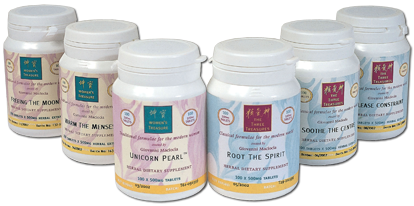
Prosperous Earth
Pattern: Spleen-Qi and Lung-Qi deficiency, Dampness
Action: tonify Spleen-Qi and Lung-Qi, resolve Dampness
Indications: poor digestion, tiredness, slight abdominal distension and fullness, poor appetite, craving for sweets, loose stools, desire to lie down, weak voice, propensity to catching colds, mild depression
Tongue: Pale
Pulse: Weak or Empty
Central Mansion
Pattern: Spleen- and Stomach-Qi deficiency, Stomach- and Spleen-Yin deficiency, Dampness in the Middle Burner, Lung-Qi deficiency
Action: Tonify Stomach- and Spleen-Qi, nourish Stomach- and Spleen-Yin, resolve Dampness, stop diarrhoea, tonify Lung-Qi.
Indications: Loose stools, diarrhoea, poor appetite, poor digestion, a slight feeling of fullness and heaviness of the epigastrium, nausea, weakness of the limbs, epigastric pain, tiredness, late onset diabetes.
Tongue: Pale, slightly Swollen, sticky but thin coating which may be rootless, Stomach crack or cracks.
Pulse: Weak in general, slightly slippery
Brocade Sinews
Pattern: Chronic Wind-Damp Painful Obstruction (Bi) Syndrome with Liver-Blood and/or Liver-Yin deficiency
Action: Nourish Liver-Blood and Liver-Yin, benefit sinews, expel Wind-Dampness from the joints.
Indications: chronic soreness and slight swelling of the joints, dizziness, numbness or tingling of limbs, poor memory, insomnia, dry skin and hair, dry eyes, blurred vision.
Tongue: Pale and thin or Red and thin without coating
Pulse: Choppy or fine, possibly only on the left side.
Precious Sea is specifically for any gynaecological problem that derives from Blood deficiency.
Brighten the Eyes is for Blood deficiency which manifests with symptoms in the head, and specifically in the eyes.
Brocade Sinews is for Bi syndrome with an underlying Blood or Yin deficiency.
By Giovanni Maciocia
A CASE HISTORY OF CHRONIC BRONCHITIS
24/10/2015
A case history on chronic bronchitis from Jason Smith in Madrid.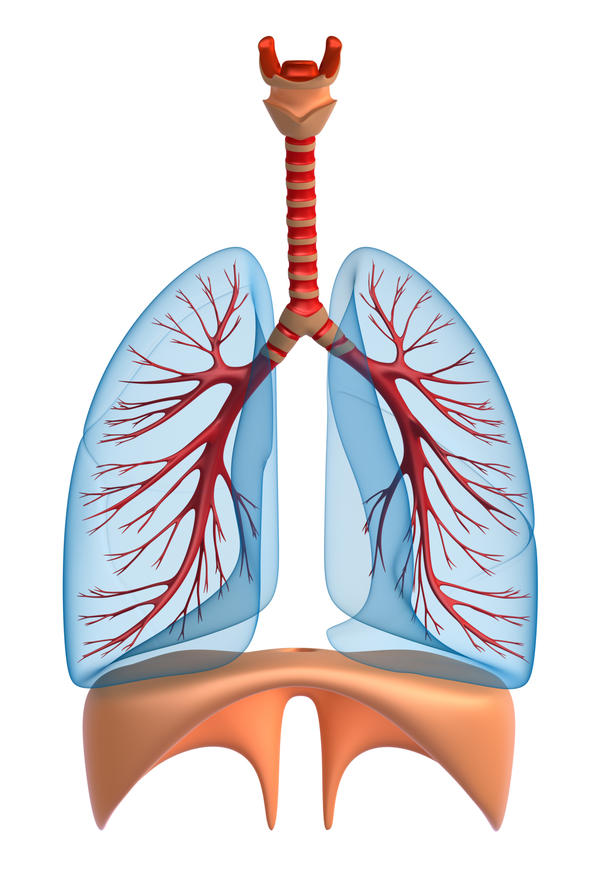
A 35 year old woman sought herbal treatment for chronic bronchitis.
The problem started 5 years ago with a flu. For a while, the flu did not seem to go away, since the flu like feeling persisted for some time. After a couple of months, and seemingly recovered from it, she developed a bronchitis.
For the past 5 years she had several cases of bronchitis. They all started the same way. Every winter, after contracting a cold, this cold progressed to bronchitis.
Tired of this situation, she sought treatment specifically with herbal medicine (not acupuncture), although in her own words, "I had little faith in these strange Chinese pills..."
Patterns
As for patterns, this is an obvious case of residual pathogenic factor in the Lungs. The first flu she contracted 5 years ago was of course a case of Wind-Heat at the Wei Level according to the Wen Bing School.
However, the pathogenic factor was not completely expelled at that time (accounting for the flu like feeling experienced for some time after), and remained in the body as a residual pathogenic factor, being latter responsible for the recurrent cases of bronchitis over the next winters.
There was also an obvious Lung deficiency, accompanied also by a Spleen deficiency. The Spleen deficiency was diagnosed because of slow digestions, swelling of the abdomen after eating, poor appetite and teeth marks on the sides of the tongue, and the Lung deficiency because of a slight spontaneous sweating, a propensity to catching colds and a weak Lung pulse.
It is also interesting to note that this woman was a yoga teacher and a vegetarian. It was my assumption that her eating habits had led to a Spleen Qi Xu, and that Spleen Xu had, on the other hand, led to a situation where the Earth could not generate (nourish) Metal.
On the other hand, although Yoga is obviously a great exercise, this patient taught Yoga for 6 hours a day, 6 days a week: this would be a form of "overwork" and it would weaken the Spleen and Kidneys. Treatment
The treatment was aimed at a) expelling the residual pathogenic factor and b) tonifying the Lungs and Spleen. The first issue was addressed with a remedy from the Little Treasures (although specific for children, it is not exclusively used for children), Resolve Phlegm.
This remedy is a variation of Wen Dan Tang and is specific for the treatment of residual Phlegm Heat in the Lungs. Since this remedy is, in the long run, detrimental for the Spleen (because of the cold herbs), she was instructed to take it during only for one month.
On the other hand, a Spleen/Lung tonic was also administered to strengthen the Spleen and the Lungs: Central Mansion, a variation of Shen Ling Bai Zhu San. She was instructed to take this for three months.
Results and prognosis
The patient sought treatment last September, and has not had a single cold or bronchitis for the past 9 months (winter included) as of May.
Although the treatment has been successful, it is my assumption that a further treatment should be undertaken, aimed at tonifying the Kidneys.
Apart from the Lungs, the Kidneys play also a crucial role in the defensive system of Wei Qi, through the 8 Extraordinary Vessels. These vessels are all related in some fashion to the Kidneys, and circulate Jing, and this Jing also contributes to the protection of the body against pathogenic factors, along with the Wei Qi and the Ying Qi.
For this reason, a further treatment might be advisable to tonify the Kidneys: a good option would be the Three Treasures remedy Herbal Sentinel (Yin o Yang), that strengthens Lung-Spleen-Kidney Qi and nourishes Yin or Yang as required by the constitution of the patient.
It is also interesting to note here the Chinese medicine point of view on invasions of Wind Heat/Cold: in western countries, it is customary for people to keep on working and carrying out their daily activities even if they are in the middle of a cold, and not taking time to rest and completely recover, something completely discouraged from the Chinese point of view. This custom is a major cause of formation of residual pathogenic factors, that can give rise to problems at a later stage.
Ganoderma Lucidum reduces obesity in mice
23/09/2015
Ganoderma Lucidum reduces obesity in mice by modulating the composition of the gut microbiota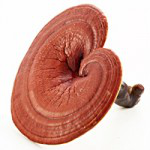
Traditional Chinese Medicine has a long history in Asian countries dating back several thousands of years, One class of traditional remedies commonly in use consists of medicinal mushrooms such as Ophiocordyceps sinensis, Antrodia cinnamomea and Agaricus blazei Murrill, which contain a wide range of immuno-modulatory and bioactive compounds. One of the most intriguing medicinal mushrooms is the Basidiomycete fungus Ganoderma Lucidum, which has been used for centuries to promote health and longevity. Previous studies have shown that triterpenes and polysaccharides isolated from Ganoderma Lucidum inhibit adipocyte differentiation and produce hypoglycaemia effects in diabetic mice. In addition, proteoglycans isolated from Ganoderma Lucidum fruiting bodies induce antidiabetic, antihyperlipidemic and antioxidant activities8. However, it remained unknown whether Ganoderma Lucidum produces any effect on body weight and obesity-related disorders.
Obesity is defined as a disease condition associated with numerous health problems and a reduced life expectancy9. Growing evidence indicates that obesity is closely linked with chronic, low-grade inflammation, which can lead to insulin resistance, type 2 diabetes, fatty liver disease, cardiovascular disease, obstructive sleep apnoea and cancer. The high prevalence of obesity is currently a major threat to public health, with 500 million obese people and 1.4 billion overweight individuals worldwide. Prevention of obesity thus represents a major challenge for modern societies.
A recent study indicates that changes in the composition of the gut microbiota are associated with the development of obesity and its associated metabolic disorders. The gut microbiota comprises trillions of bacteria that contribute to nutrient acquisition and energy regulation. An increased ratio of the major phyla Firmicutes/Bacteroidetes and changes in several bacterial species can promote the development of obesity in both dietary and genetic models of obesity in mice. Other studies in obese animals suggest that obesity-induced gut dysbiosis caused by either environmental or genetic factors impairs intestinal integrity. This process leads to the release of the endotoxin lipopolysaccaride (LPS) from intestinal Gram-negative bacteria into the bloodstream, in turn, leading to metabolic inflammation and insulin resistance in obese mice due to stimulation of Toll-like receptor 4 (TLR4)-mediated inflammation. Moreover, chronic injection of LPS in mice leads to mild obesity and insulin resistance21, highlighting a possible role for microbiota-derived LPS in obesity-induced inflammation.
A number of treatments, including antibiotics and prebiotics, are being evaluated for the management of obesity and its related metabolic disorders. For example, antibiotic treatment alters the gut microbiota, reduces blood endotoxemia and improves glucose tolerance in mice lacking the leptin gene (ob/ob mice) or in mice fed with a HFD19. In addition, prebiotics are non-digestible, fermentable carbohydrates and fibres, which reduce body weight and exert anti-inflammatory effects mainly by enhancing the growth of specific beneficial bacteria found in the gut. Prebiotics not only alter the intestinal microbiota but also improve intestinal tight junction integrity and decrease blood endotoxemia caused by LPS18. Prebiotics may, therefore, protect animals against obesity-induced inflammation.
In the present study, we examined whether a water extract of Ganoderma Lucidum mycelium (WEGL) can decrease obesity in HFD-fed mice. Our results indicate that WEGL reduces obesity and inflammation in the treated mice. These effects are transmissible to HFD-fed mice through horizontal faeces transplantation, indicating that the effects of WEGL involve the gut microbiota. Characterization of WEGL showed that polysaccharides of molecular weight >300?kDa exerted similar ameliorative effects as WEGL. These results implied that the high molecular weight polysaccharides may be the active components of WEGL. Our data thus demonstrate that WEGL represents a potential prebiotic agent that may be used for the treatment of obesity and its complications.
in "Nature" 23rd June 2015.
The Five Elements and Diet in Chinese Medicine
01/07/2015
Along with the Eight Principles (Yin and Yang, excess and deficiency, hot and cold, interior and exterior), the various forms of Qi (energy) that course through the meridians or bioelectric pathways, Blood, the Zang and Fu organs — the la 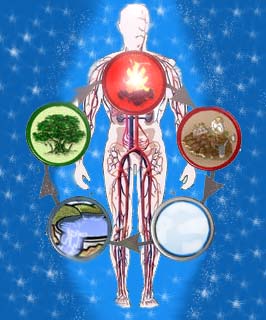 theory of the Five Elements forms the basis for the understanding of how acupuncture and Chinese Medicine works. By means of the interconnecting system of the meridians, the Five Elements maintain a relative balance and coordination.
As you know Chinese Medicine has been around for at least 3000 years since the Shang Dynasty when the hieroglyphs of acupuncture and moxibustion first appeared. The theory of the Five Elements was developed by the same school that developed the theory of Yin and Yang. The chief exponent of this school being Zou Yan (circa 350-270 BC).
The key to diagnosis in Five Element Acupuncture is discerning the root imbalance. Each of the Five Elements has a corresponding emotion, flavor, organ, sense, tissue, season, color, etc. that can be perceived when that element is out of balance.
The Five Elements are comprised of the following:
Fire – Heart – Shen or Mind. Associated with consciousness and relatedness, inspiration, joy, laughing, communication, oneness, compassion. Connected with the blood vessels and the tongue. The Ruler of Spirit. Responsible for nourishing his kingdom. Anything which disturbs the Shen or the Mind causes memory problems. The season of Summer.
Earth – Spleen – Yi or Thought, the capability to create structures — physically, mentally and emotionally. Understanding, receiving, contemplation on the positive side. Worry or getting into a rut on the negative side. Connected with digestion and the muscles. Indian Summer.
Metal – Lungs – Po or Corporeal Soul, the Storehouse of Vitality. Your “shield” — the immune system. The energy which keeps you protected. The ability to let go. Associated with the emotions of grief and letting go. The season of Fall.
Water – Kidney – Zhi or Will Power. The storehouse of the Will to survive. Connected with the Bones. On a positive note it nourishes the backbone. On the negative side it results in fear. Relates to the season of Winter, hibernation, conservation, preservation, sexual power, the Fountain of Youth, fertility, long term memory, the low back, knees and the ears.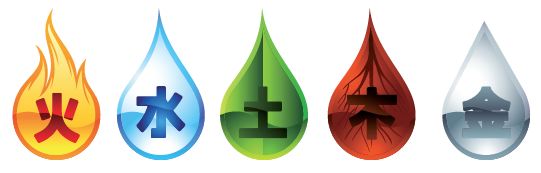 Wood – Liver – Hun or Ethereal Soul. Wood’s function is about maintaining a harmony of flow, a strategizing function. It gives a sense of one’s ability to wander gracefully through life. Connected with the emotions of depression, frustration and anger: When the spirit is obstructed people “snap”. Connected with “Wind” as manifested in convulsions and tremors. Connected with ligaments, tendons, spasms and vertigo. The season of Spring.
Foods which Nurture based on the Five Elements:
(Eat foods from organic/pasture-raised animals, or wild-caught foods whenever possible. Avoid foods that have been exposed to pesticides or antibiotics.)
Foods which nurture the Heart: Whole wheat, brown rice, oats, mushrooms, barley gruel, cucumber, celery, lettuce, mulberries, lemons, jujube seeds, cow and goat milk, clarified butter (ghee). 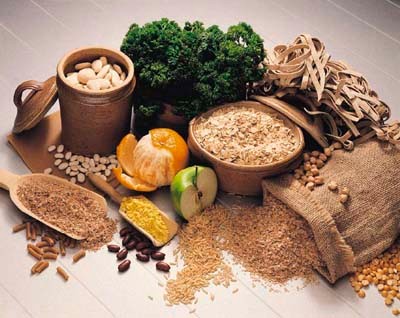
Foods which nurture the Spleen: Barley, bean curd, beef, bitter gourd, black soybean, dehydrated unprocessed brown sugar, carp (common, gold and grass), carrot, chestnut, chicken, cinnamon bark, clove, coriander, cucumber, date (red and black), dill seed, eel, eggplant, fig,garlic, ginger (fresh and dried), ginseng, grape, grapefruit peel, green pepper, hawthorn fruit, honey, Job’s tears, licorice, litchi, longan, loquat, lotus fruit and seed, malt, mutton, nutmeg, peanuts, pork, red pepper, rice, squash, star anise, string bean, sweet basil, wheat, yellow soybean.
Foods which nurture the Lungs: Carrot, castor bean, Chinese wax gourd, cinnamon twig, common button mushroom, coriander, crab apple, duck, garlic, ginger, leek, licorice, lily flower, loquat, milk, olive, peanut, pear, peppermint, persimmon, radish, dehydrated unprocessed sugar cane, sweet basil, tangerine, walnut, water chestnut, wine.
Foods which nurture the Kidneys: Black sesame seed, black soybean, caraway, kidney beans, asparagus, chestnut, chicken egg yolk, chive, chive seeds, cinnamon bark, clam (freshwater), clove, cuttlebone, cuttlefish, dill seed, duck, eel, fennel, grape, grapefruit peel, Job’s tears, lotus fruit and seed, mutton, plum, pork, salt, star anise, string bean, tangerine, walnut, wheat, watermelon and other melons, blackberry, mulberry, blueberry, sardine, crab, lamb, seaweed.
Foods which nurture the Liver: Black sesame seed, brown sugar (raw unrefined), celery chicory, chive, chive seed, clam (freshwater, clamshell (river), crab, crab apple, cuttlefish, eel, hawthorn fruits, leek, litchi, loquat, peppermint, plum, saffron, sour plum, star anise, vinegar, wine, kale, collards, spinach, turnip tops, beet tops, dandelion greens, romaine lettuce, endive, radicchio, arugula, turmeric, basil, cardamom, cumin, fennel, ginger, strawberry, peach, cherry.
Daoist Sexual Practices
23/05/2015
The essence of Daoist sexuality is the idea that the sexual act is an exchange of Yin and Yang essences, from the woman and man respectively, which is beneficial to each partner: it represents the harmonious interaction and mutual nourishment of Yin and Yang. 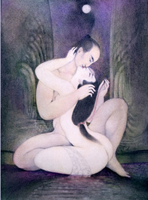
Central to Daoist sexuality is the idea that man must conserve its sperm and only ejaculate occasionally: this is because sperm is a direct physical manifestation of Jing and too frequent ejaculation depletes Jing. If sperm is not ejaculated and directed upwards along the Du Mai to the brain, it can be transmuted and then lowered down to the Dan Tian where it nourishes the body and mind.
Since excessive ejaculation weakens the Jing, and since sex without ejaculation can replenish the Jing, it follows that Jing lost through sexual activity can be replaced by sexual energy itself, by practising sex without ejaculation.
Sexual intercourse was considered to have two aims: first to produce sons who would continue the family (and look after the parents' grave). This was a sacred duty to one's ancestors since the well-being of the dead could only be ensured by regular sacrifices made by their descendants, especially the male ones.
The second aim (more relevant to us) was to strengthen a man's vitality by making him absorb the Yin essences of the woman. As a matter of course, these two aims were closely interwoven.
In order to obtain healthy male children the man's Yang essence should be at its apex when he ejaculates, and ancient sex manuals frequently pointed out the optimal conditions the best conditions for a healthy child: at the time of ejaculation and subsequent conception, the man should not be in a state of exhaustion and should not drink alcohol, for example.
To the Daoists, sex was like a process of alchemy, of transformation of the sexual essences into Qi and Jing, through the harmonious intermingling of Yin and Yang. They identified the woman with a crucible and her vital essence with cinnabar (red); they identified the man's white semen with lead; the coitus with the mixing of the elements, and the technique of the coitus with the firing times.
Since men had to restrain themselves by not ejaculating whereas women could reach an orgasm whenever they liked, the onus was very much on men to conduct and prolong sexual intercourse by sexual expertise; in fact, because of this, sexual intercourse is often described by the Daoists as a "battle", as "riding a tiger", or as "walking on the edge of a precipice": i.e. man is easily aroused and easily ejaculates and must learn to control his ejaculation to prolong sexual intercourse (see below).
There were also social reasons for this as the sexual art was essentially for the upper classes whose men had a wife and concubines and they therefore had to restrain themselves in order to satisfy them all.
A constant theme running through Daoist sex manuals is that excessive ejaculation is detrimental to health. This is because too frequent ejaculation leads to a direct loss of Jing and also Minister Fire: thus it depletes both Water and Fire. As we all know, this is very much a theme of modern Chinese medicine books where "excessive sexual activity" features prominently in the aetiology of diseases. As I will explain below, I think that this cause of disease does not apply to women.
The role of the Ming Men (Minister Fire) in human physiology should be discussed. The Fire of Ming Men represents the physiological Fire within the Kidneys, it arises from the area between the two kidneys and is closely related to the Yuan Qi from which the Du, Ren and Chong Mai originate.
Under physiological conditions, the Fire of Ming Men warms the Uterus, the Intestines, the Bladder and the Heart and balances the Yin influences: it makes conception possible and is related to sexual desire. In women, "it is through Kidney-Yang [and therefore the Fire of Ming Men] that the Tian Gui turns red [i.e. it turns into Blood]".1
The Fire of Ming Men is the origin of the "formless" Minister Fire which also generates Water, hence the Kidneys are the source of both Water and Fire. This physiological Fire is unique in that, not only it does not dry up Water, but it can nourish Water..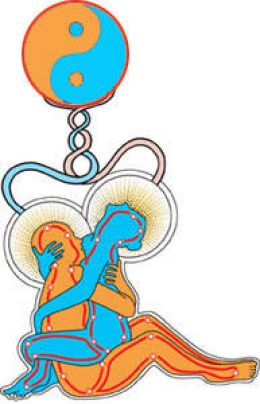 The Minister Fire is called "formless" because it is a non-substantial Fire which actually generates Water rather than overcoming it. It is a Pre-Natal type of Fire formed at conception on the Du/Ren Mai axis.
In fact, the "Golden Mirror of Medicine" (1742) says: "The Pre-Natal Tian Gui originates from the mother and father, the Post-Natal Jing and Blood are derived from food and water, a girl's Tian Gui matures at 14, when the Ren Mai is open, the Chong Mai is flourishing and the periods arrive".2
The commentary then explains: "At 7 the Motive Force [Dong Qi] is flourishing. At 14 the Tian Gui matures: this is the Motive Force within the Pre-Natal Water of Tian Gui, crystallizing in a girl's uterus".3
"Motive Force" (Dong Qi) is the Yuan Qi. This last passage is interesting as it confirms that the Yuan Qi and the Minister Fire are pre-natal and present before the onset of the periods. It also highlights the close integration of the Minister Fire and the Tian Gui (the Yang and Yin aspects of the Kidneys).
Zhang Jing Yue says: "The Ming Men is the Root of the Yuan Qi and the residence of [both] Water and Fire. The Yin of the 5 Zang cannot nourish without it and their Yang cannot develop without it".4
This passage clearly shows how the Minister Fire is the Fire within Water, interdependent with Water and inseparable from it. The Emperor Fire (of the Heart) is called "with form", i.e. it is a substantial Fire which overcomes Water, is formed after birth and is therefore post-natal.
It is important to note again that the Minister Fire cannot be seen in the context of the Five Elements, it is not like the Fire of the Heart and it is a Fire within Water of the Kidneys that actually nourishes Water.
DIFFERENCES BETWEEN WOMEN'S AND MEN'S SEXUALITY
Women pertain to Water and men pertain to Fire and there are important differences in their sexuality. Women are like water, i.e. slow to bring to the boil and slow to cool down; men are like fire, i.e. easy to arouse and quick to cool down.
Ever since very early times, Chinese sexual manuals stressed that women like "slowness" and "duration" and abhor "haste" and "violence". This difference is the crux to understand the different sexual behaviour by men and women necessary or a successful sexual life. For this reason, all Daoist texts stressed very much the importance of expert foreplay by the man to arouse his partner and hence the detailed description of the signs of women's arousal.
From the point of view of Chinese medicine, there are important differences between men's and women's sexuality. In men, the lower Dan Tian contains the "Room of Sperm" and is, so to speak, "empty"; in women, the lower Dan Tian is, so to speak, "full" as it contains the Uterus and Blood. Excessive sexual activity does not affect women as much as men for various reasons.
In men, ejaculation is a direct (but temporary) loss of Jing as sperm is derived directly from the Jing. Sperm is Tian Gui whereas Tian Gui in women is menstrual blood and ovarian follicles and eggs. As in sexual activity men lose sperm but women do not lose menstrual blood (unless they have sex during the period which they should not do) or follicles.
As there is no comparable loss of Jing in women as there is in men, there is no equivalent depletion after sex. Quite simply, the Kidney-Jing is the origin of sperm in men and of menstrual blood and ova in women: while men lose sperm during sex, women do not lose menstrual blood or ova.
Although some practitioners consider the lubricating fluids secreted by the Bartholin's glands during sexual arousal in a woman to be also a manifestation of Jing comparable to sperm, I tend to disagree because such fluids are secreted by glands in the vagina and not by sex organs (such as the ovaries in women or testicles in men): I would therefore consider these fluids precisely as a form of Body Fluids (jin ye) rather than a direct manifestation of Jing. In fact, the Bartholin's glands in the vagina are homologous to the Cowper's glands in men and their function is purely lubricative.
In other words, sperm is a direct manifestation of Jing, the equivalent of which would be the ova and menstrual Blood in women: the former is lost in men's orgasm, the latter are not lost in women's orgasm.
Furthermore, the Lower Dan Tian in men contains the Room of Sperm which is directly related to Jing, while in women it contains the Uterus which is related to Blood. The Room of Sperm is related to the Kidneys while the Uterus is related also to the Liver and Blood (although also to the Kidneys through the Bao Luo). Because the Lower Dan Tian in women contains the Uterus rather than the Room of Sperm, in women excessive loss of blood after childbirth or excessive loss of blood in menorrhagia would be equivalent to excessive sex for men.
In men, the lower abdomen is occupied by the Room of Sperm and it is therefore "empty", also because sperm is easily discharged while Blood is not.
The book "Elementary Medicine" (1575) says: "The Room of Sperm in men suffers no accumulation or fullness, while the Blood Chamber in women suffers from accumulation and it overflows downwards in the period....[The Lower Dan Tian] in men stores Jing [=sperm] while in women it stores the Uterus and foetus. Men pertain to Qi and when it mixes with the Abysmal [the trigram corresponding to Water], Qi makes Water steam and produces sperm which is white... Women pertain to Blood, when this mixes with the Clinging [the trigram corresponding to Fire], Blood is transformed into the period which is red".5
By Giovanni Maciocia
END NOTES
1. Cong Chun Yu 1989 Chinese Medicine Gynaecology (Zhong Yi Fu Ke Xue), Ancient Chinese Medicine Texts Publishing House, Beijing, p.11.
2. Wu Qian 1977 Golden Mirror of Medicine (Yi Zong Jin Jian), People's Health Publishing House, Beijing, vol. 3, p.7. First published in 1742.
3. Ibid., p. 7.
4. Zhang Jing Yue 1986 The Complete Works of Jing Yue (Jing Yue Quan Shu), Shanghai Science and Technology Press, Shanghai, p.19. First published in 1624.
5. Elementary Medicine (Yi Xue Ru Men ) 1575 cited in Zhang Qi Wen 1995 Menstrual Diseases (Yue Jing Bing Zheng), People's Hygiene Publishing House, Beijing, p.10.
DEPRESSION
21/02/2015
You lay down at night and you roll from one side of the bed to the other all night long, you can't sleep, what's the matter? The blues has got you. You get up and sit on the side of your bed in the morning and you may have a sister, brother, mother and father around you but you don't want no talk out of them, what's the matter? The blues has got you. You go and put your feet under the table and look down on your plate and you've got everything you want to eat but you shake your head and get up and say "Lord, I can't eat, I can't sleep", what's the matter? The blues has got you.
The purpose of this article is to take an in-depth look at the Three Treasures and Women's Treasure remedies which are applicable in the treatment of mental and emotional disorders ranging from severe depression on the one hand to anxiety, obsessive thinking and worry on the other.
CHINESE VIEW OF DEPRESSION
The Chinese term for depression is yu or yin yu. "Yu" has the double meaning of "depression" or "stagnation".
Yu as stagnation
The "Simple Questions" in chapter 71 talks about Five Stagnations of Wood, Fire, Earth, Metal and Water. It says: "When Wood stagnates it extends, when Fire stagnates it rises, when Earth stagnates it seizes, when Metal stagnates it discharges, when Water stagnates it pours."
The "Essential Method of Dan Xi" (Dan Xi Xin Fa 1347) talks about Six Stagnations of Qi, Blood, Dampness, Phlegm, Heat and Food. It says: "When Qi and Blood are harmonized, no disease arises. If they stagnate diseases arise. Many diseases are due to stagnation...stagnation makes things accumulate so that they cannot flow freely, they would like to rise but cannot, they would like to descend but cannot, they would like to transform but cannot...thus the 6 Stagnations come into being".
The "Complete Book of Jing Yue" (Jing Yue Quan Shu 1624) gives it an emotional interpretation and talks about Six Stagnations of anger, pensiveness, worry, sadness, shock and fear. This confirms that all emotions can lead to stagnation of Qi. He said: "In the Six Stagnations, stagnation is the cause of disease. In emotional stagnation, the disease [i.e. the emotion] is the cause of the stagnation."
Yu as mental depression
"Yu", besides meaning "stagnation" also means mental depression and Chinese books usually ascribe it to Full causes, i.e. Liver-Qi stagnation, Qi stagnation turning to Fire, and Qi-Phlegm, and a heavy emphasis is put on Liver-Qi stagnation at least in the beginning stages. In the later stages, they talk about Qi-Blood-Yin deficiency.
Thus, in Chinese medicine stagnation and depression are almost synonymous implying that all depression is due to stagnation. However, this is not true in practice as there are many types of depression due to Deficiency, and especially Kidney deficiency. It is true, however, that also within the Deficiency types there is an element of stagnation which manifests in the typical resistance to improvement by chronic depressives.
THE MIND (Shen)
Shen is our consciousness which allows us to feel our emotions. For example, when we are angry it is due to the Liver, but it is the Shen of the Heart that feels the anger and knows that we are angry. Therefore one of the functions of the Shen is that it governs our emotional life and by implication it is therefore always involved in mental and emotional conditions.
This explains partly why a Red tip of the tongue is such a common clinical finding. It does not necessarily indicate a problem solely with the Heart, but it could have its root in any emotion affecting any organ, e.g. worry and pensiveness affecting the Spleen, sadness affecting the Lungs, anger affecting the Liver. Such emotions affect various organs but the Heart, housing the Shen, is the organ that "feels" them.
THE ETHEREAL SOUL (Hun)
While the Shen gives us our consciousness as a human, the Hun belongs to a different world - to the world of the spirits. The Hun is Yang in nature and it is imparted to the child three days after birth.
The nature of the Hun is that it is constantly moving, searching and exploring; it is never still. When the Hun wanders a bit at night, we dream - this is normal. However, if there is excessive dreaming, the Hun is searching, moving etc. too much. It is interesting to note that from a Western point of view, the most dreaming occurs during REM phase of sleep when the eyes are flickering and from the Chinese point of view the Liver controls and nourishes the eyes.
So the Hun is an essential complement to the Shen because it gives it this coming and going movement, which manifests as our ability to have plans, vision, inspiration, sense of direction, relationships etc. Without the Hun, the Shen would be like a computer without software.
THE SHEN AND THE HUN IN DEPRESSION
The relationship between Shen and Hun is everything in depression; they cannot function without each other and their relationship must be balanced in order for a person to be mentally and emotionally healthy. The Hun gives the Shen the movement of coming and going - this manifests as being able to cultivate relationships with other people, a relationship with the environment, to have plans, dreams, creativity, inspiration, original thinking and vision. These things all come from the Hun and not from the Shen and the Heart. When a person is undecided and unsure of what to do with their life, it is due to the Hun not having that movement, and coming and going as it is in its nature to do.
On the other hand, the Shen gives the Hun control and integration. If the Shen does not control the Hun, the Hun will be "coming and going" too much. Furthermore, the Shen has to integrate all these things into the consciousness. The Hun is a sea of ideas that bubble up all the time and the Shen can only deal with one at a time so it has to control the Hun and integrate all the material coming from the Hun into the total psyche. We can often witness an "overactive" Hun in children who give life to inanimate objects and have an amazingly developed sense of imagination. After the age of seven, the Shen begins to become stronger and gradually "orders" and "controls" the imaginings of the Hun.
We can therefore see the role that the Shen and the Hun play in bipolar depression. The Hun is being "overactive" and producing endless ideas but the Shen is not able to integrate them: that is why manic depressives are often very creative. So in the manic phase of bipolar depression the Hun is coming and going too much. In extreme cases of mania, it becomes psychotic and causes "madness". However, it exists in many different degrees and is not always as extreme as this. In a milder degree, people have lots of ideas, start lots of courses, become very active at night, restless, confused, spend too much money - nothing ever comes to fruition.
Conversely, when the Hun isn't coming and going enough, the depressive phase of bipolar disease sets in. This manifests in extreme lethargy, fatigue, disinterestedness, despair, apathy and a feeling of hopelessness, lack of vision, lack of plans, etc...
 DEPRESSION
SHI CONDITIONS
Liver Qi Stagnation
Depression, moodiness, anxiety, frustration, uptight, tense, pre-menstrual tension. Wiry pulse. Often the subdued and depressed appearance of the patient may belie the true origin of the problem, but the Wiry pulse gives it away.
Three Treasures remedies: Release Constraint, Freeing Constraint .
Liver-Qi Stagnation Turning Into Fire
Anxiety, depression, agitation, short-temper, a feeling of oppression of the chest, tongue Red on the sides with a yellow coating, Rapid-Wiry pulse.
Three Treasures remedy: Freeing the Sun.
Diaphragm Heat
Mental restlessness, depression, anxiety feeling below the heart, insomnia, yellow tongue coating, Rapid pulse.
Three Treasures remedy: Clear the Soul.
Phlegm-Heat Harassing Mind
Mental restlessness, depression, agitation, restless sleep, excessive dreaming, Swollen tongue with a sticky tongue coating, Slippery pulse.
Three Treasures remedy: Clear the Soul.
Stagnation Of Qi With Phlegm
Moodiness, up and down, pre-menstrual tension, also mild symptoms of "Dian" such as apathy, forgetting to eat, slowed thinking, sleep disturbance, tongue coating sticky, Wiry or Slippery pulse.
Three Treasures remedies: Clear the Soul, Open the Heart
MIXED CONDITIONS
Liver-Blood Deficiency Leading To Liver-Qi Stagnation
Pre-menstrual tension, frustration, tension/irritability before the period, crying and tiredness after the period, insomnia, lack of direction, Pale tongue, Wiry-Choppy or Thin pulse.
Three Treasures remedies: Freeing the Moon , Precious Sea, Calm the Shen.
EMPTY CONDITIONS
Worry Injuring The Mind
Depression, absent, anxiety, no desire to do anything, sadness, worry, crying, stretching and yawning, tongue Pale, tongue coating sticky-white, Wiry and Fine pulse.
Three Treasures remedies: Calm the Shen, Breaking Clouds.
Heart And Spleen-Blood Deficiency
Brooding, depression, always thinking, palpitations, timidity, difficulty in falling asleep, poor appetite, Pale tongue, Weak or Choppy pulse.
Three Treasures remedy: Calm the Shen .
Heart Yang Deficiency
Depression, chilliness, curling up, not wanting to do anything, anxiety, palpitations, easily startled, insomnia, Pale tongue, Deep-Weak or Knotted (in severe cases) pulse.
Three Treasures remedy: Breaking Clouds .
Yin Deficiency With Empty-Fire Blazing
Depression, anxiety in the evening, mental restlessness, insomnia, Red tongue, Wiry-Fine or Floating-Empty pulse.
Three Treasures remedy:Root the Spirit .
Kidney-Yang Deficiency
Exhaustion, depression, does not want to do anything or go out, weariness, chilliness, curling up, no will power, no initiative, very Pale tongue, Weak-Deep-Slow pulse.
Three Treasures remedy: Strengthen the Root , Breaking Clouds.
THE THREE TREASURES FORMULAE FOR TREATING DEPRESSION
Breaking Clouds
Depression can be caused by many patterns and the present formula, a variation of Bu Zhong Yi Qi Tang, addresses depression primarily from Qi deficiency and secondarily from Qi stagnation. Its primary action is that of "lifting" things, both on an emotional and physical level.
This person, on the one hand, may have a mild case of depression manifesting in a chronic low mood, despondency and depression. On the other hand, they may be intensely depressed and suffer from lack of self-esteem and self-confidence. They will find pleasure in nothing and will suffer from intense feelings of guilt. Although they may bravely try to soldier on, they are in a constantly depressed mood and the strain of carrying on may sometimes feel too much for them. They will have a feeling of unreality and will find it difficult to cope socially; they have a tendency to bouts of crying and will often describe their feeling as "if being in a dark tunnel without exit".
Release Constraint
Release Constraint is extremely effective in dealing with emotional strain and depression deriving from stagnation of Liver-Qi especially, though not exclusively, in men. It is indicated when the condition is predominantly a Full one, i.e. not when the stagnation of Liver-Qi derives from an underlying deficiency.
The formula addresses the emotional and mental manifestations of stagnation of Liver-Qi when it causes the Shen to be obstructed: moodiness, mental depression, pre-menstrual tension, irritability, frustration, annoyance and impatience. A typical feature of this condition of Shen obstructed is first of all a certain mental confusion deriving from stagnation, and secondly, a strong resistance to any mental or affective change. This person may have a huge amount of pent-up anger but be unable to use this to help bring about positive change.
A person suffering from severe Liver-Qi stagnation will not always appear angry and raging. In some cases, Liver-Qi stagnation can equally cause someone to appear subdued, quiet, depressed and introverted.
Freeing the Moon
This variation of the classical prescription "Free and Easy Wanderer" (Xiao Yao San), aims at treating pre-menstrual emotional strain occurring against a background of Liver-Qi stagnation and some Liver-Blood deficiency.
The patient will feel tense, wound-up and irritable, but also rather sad and depressed. They may oscillate between crying and flying off the handle. Thus on the one hand Liver-Blood deficiency causes the Hun to be unrooted and on the other hand stagnation of Liver-Qi harasses the Hun giving rise to irritability and depression.
The combined patterns of Liver-Qi stagnation against a background of Liver-Blood deficiency are seen together especially in women, when the Liver-Qi stagnation is especially predominant before the period. The subject around which a woman is depressed pre-menstrually may not cause her any concern for the rest of the month. However, if the same issues cause a woman to be depressed pre-menstrually month after month, it indicates that these issues need to be addressed and are very "real" (even though they may not bother her at other times).
Clear the Soul
This formula, a variation of "Warming the Gall-Bladder Decoction" (Wen Dan Tang) is aimed at treating emotional tension and anxiety occurring against a background of Phlegm obstructing the chest and therefore the Lungs and Heart.
The formula is called Clear the Soul because on the one hand it settles the Hun by resolving Phlegm and clearing Heat and on the other it releases tension of the Corporeal Soul by relaxing the chest and Lungs.
Phlegm-Heat disturbs the Shen in two ways: Phlegm obstructs the Mind's orifices and Heat agitates the Shen. The combination of these two factors will cause mental restlessness and manic behaviour alternated with severe depression, crying or laughing without reason and insomnia. The patient may feel jumpy and talk of a "flustered feeling" in the heart region. This could be seen as a very mild form of dian-kuang (as discussed above). In women, these symptoms may only appear pre-menstrually, in which case the formula need only be taken during the fourth phase of the menstrual cycle.
This pattern is usually caused by pensiveness, jealousy, worry, or obsessive thinking over a long period of time. The more obsessive a person's thinking becomes, the more Heat is created and the more Heat there is, the more the person will be prone to over-thinking: thus a vicious circle is created.
Open the Heart
Open the Heart is a variation of "Pinellia-Magnolia Decoction" (Ban Xia Hou Po Tang). It is aimed at dealing with emotional strain deriving from worry, frustration, or bottled-up anger, manifesting as tightness of the chest or a feeling of obstruction of the throat. The formula is often cited as one to move Liver-Qi when in fact its clinical use is really to deal with stagnation of Qi in the chest deriving not so much from the Liver as from the Lungs and Heart.
This person becomes anxious as well as sad, feels depressed, sighs frequently and has the typical feeling of obstruction in the throat and chest. This is caused by the constriction of the Corporeal Soul in the throat and chest. The chronic stagnation of Heart-Qi obstructs the Shen and causes severe confusion. Therefore this formula is used literally to "get it off one's chest".
Whereas Liver-Qi stagnation derives often from pent-up and unexpressed feelings, stagnation of Heart- and Lung-Qi derives more from chronic worry and sadness. Therefore, where Open the Heart is indicated, the person will have a sense of someone whose soul is not at peace and they may be dealing with very deep issues in their life.
Calm the Shen
Calm The Shen treats the conditions of Spleen- and Heart-Blood deficiency. These patterns are caused by sadness, grief, worry or shock over a long period of time. These emotions deplete Qi of the Spleen, Heart and Lungs and, after some time, this gives rise to Blood deficiency. This patient will be sad, despondent, depressed and weary: he or she is prone to bouts of crying especially at the end of the day or when tired. Since this crying derives from a deficiency rather than from repressed, stagnant Qi, it does not relieve the mental state.
This pattern is commonly seen in students who are doing a lot of mental work and have a poor diet - both factors which weaken the Spleen. They may oscillate between feeling anxious and uptight about their work on the one hand, and sad, depressed and despondent on the other hand.
Root the Spirit
Root the Spirit is a variation of the ancient prescription "Attracting Sleep Decoction" (Yin Mei Tang). It is aimed at treating mental restlessness, anxiety, vexation and insomnia deriving from a deficiency of Liver-Blood and/or Liver-Yin; this leads to the Hun being unrooted and the person feeling restless and aimless.
Frustration, resentment, or old grudges can cause Liver-Blood or Liver-Yin to become deficient. The patient's Liver-Yin has been consumed by repressed anger over many years. He or she feels tense and anxious and sleeps badly, disturbed by unpleasant dreams. Another characteristic sign may be that the person has a peculiar floating sensation accompanied by a vague feeling of anxiety just as they are about to drop off to sleep.
In some cases, sadness depletes Liver-Blood or Liver-Yin. When it does, the person feels depressed and sad and sleeps badly, but does not dream much.
The patient also lacks a sense of direction and finds it difficult to focus on life's personal aims. They may seem "stuck in a rut" and be unable to see anyway out of their current situation. To ease their pain, they may resolve to work even harder which further depletes the Liver-Yin, and the more the Yin is depleted the harder they may find it to "switch off" and take a break; thus a vicious circle is created.
Freeing Constraint
The pre-menstrual tension addressed by this formula, a variation of Yue Ju Wan manifests with outbursts of anger, moodiness, depression, resentment, etc. all symptoms of severe stagnation of Liver-Qi. In this instance, the severe stagnation of Liver-Qi leads not only to unsettling of the Shen, but also a slight obstruction of the Shen. This many manifest with irrational behaviour and shouting at or hitting members of her family.
This formula addresses the emotional and mental manifestations of stagnation of Liver-Qi when it causes the Shen to be obstructed: moodiness, mental depression, pre-menstrual tension, irritability, frustration, annoyance and impatience. A typical feature of this condition of Shen obstructed is first of all a certain mental confusion deriving from stagnation, and secondly, a strong resistance to any mental or affective change.
Penetrating Vessel
This formula is specific to harmonize the Penetrating Vessel. Disharmonies of the Penetrating Vessel with rebellious Qi are very common in women. Rebellious Qi causing the feeling described as li ji in Chinese, is the major pathology of this vessel. This symptom can be interpreted on a mental level as a feeling of anxiety, or on a physical level as a tension of the connective tissues of the abdomen. Both these interpretations are valid.
This patient will feel anxious and agitated, especially pre-menstrually, as well as tired and depressed. They may be easily panicked. They will be pale and lack Shen in their eyes.
Freeing the Sun
This formula clears Liver-Heat deriving from Liver-Qi stagnation. This pattern is more common in men suffering from long-standing Liver-Qi stagnation (deriving from emotional problems) leading to some Liver-Heat. This formula could be described as a men's Freeing the Moon.
Liver-Qi stagnation is typically caused by repressed anger, frustration or resentment. This person may find it difficult to express anger appropriately, i.e. they may avoid expressing it when they have suffered an abuse as they tend to shy away from conflict, or they may "fly off the handle" at the smallest aggravation. They may oscillate between these two responses. Usually when anger is expressed it gives rise to Liver-Yang rising while, when it is repressed, it causes Liver-Qi stagnation. This patient is typically a man who is either irritable and prone to bouts of anger or he will appear depressed and subdued but the Wiry pulse betrays the pattern of Liver-Qi stagnation caused by anger. Long-term stagnation of Liver-Qi may give rise to Heat in the Liver which will cause the person also to become anxious and restless. However, this remedy is often applicable to women too.
COMPARISON OF FORMULAE
Release Constraint and Freeing the Moon
Release Constraint differs from Freeing the Moon in so far as it is suitable for cases when the stagnation of Liver-Qi predominates and the condition is primarily full. Instead, Freeing the Moon is indicated in conditions of mixed deficiency and excess, with a deficiency of Liver-Blood and Spleen-Qi and with stagnation of Liver-Qi. The pulse and tongue are good discriminating factors between these two formulae: if the pulse is Wiry and the tongue is Red, Release Constraint is indicated; if the pulse is Choppy or Fine overall and Wiry in parts, and the tongue is Pale on the sides, Freeing the Moon is indicated.
Clear the Soul and Open the Heart
Clear the Soul is indicated when there is Phlegm-Heat in the chest, while Open the Heart is indicated when there is stagnation of Qi in the chest. Both these patterns may manifest with depression and a feeling of oppression and tightness in the chest. However, in the case of Phlegm-Heat, the patient will be more restless and may show some signs of manic behaviour, whereas in the case of stagnation of Qi in the chest, these manic signs (such as jumpiness, flustered feeling) will not be present.
As the names imply, when there is Phlegm-Heat in the chest, the spirit needs to be "cleared"; when there is stagnation, the appropriate action is one of "opening" to allow Qi and stuck emotions to "move on".
The most important discriminating factors, however, are the pulse and tongue. When Clear the Soul is indicated, there will be a sticky-thick-yellow coating on the tongue and the pulse will be Slippery-Rapid. When Open the Heart is indicated, the thick tongue coating will not be present and the pulse will be slightly Wiry in the front positions, as opposed to Slippery.
Calm the Shen and Root the Spirit
Both Calm The Shen and Root the Spirit are indicated when there is Blood deficiency and therefore in both cases there will be anxiety and insomnia. However, Calm The Shen is indicated when the Blood deficiency is primarily of the Spleen and the Heart, where as Root the Spirit nourishes Liver-Blood. In terms of clinical manifestations, Calm The Shen is more suitable for someone suffering from sadness, weariness and crying, together with symptoms of weak Spleen-Qi, whereas Root the Spirit is suitable for someone suffering from anxiety, tension, insomnia and a lack of direction, together with symptoms of Liver-Blood and/or Yin deficiency.
When Spleen- and Heart-Blood deficiency are present, the spirit will be unsettled and anxious and thinking, sleep and the ability to feel joyful will be affected. As the name implies, the spirit needs to be "calmed". However when Liver-Blood and/or Yin are deficient, the Hun does not have a proper resting place and begins to wander. Therefore, it needs to be "rooted" rather than merely calmed.
Freeing the Sun and Freeing the Moon
Both Freeing the Sun (from the Three Treasures) and Freeing the Moon (from the Women's Treasure) are indicated when there is Liver-Qi stagnation against a background of Liver-Blood deficiency. However, in the case of Freeing the Sun, the chronic Liver-Qi stagnation has lead to some Liver-Heat causing additional symptoms such as a feeling of heat, slight thirst or a slight bitter taste. The sides of the tongue being Red (in the Liver area) is, in itself, enough to confirm the presence of some Heat in the Liver. In cases where Freeing the Moon is indicated, the sides of the tongue would be Pale.
In both cases, the person may oscillate between "flying off the handle" and feeling tired, tearful and lethargic. However, where Freeing the Sun is indicated, there will also be an element of restlessness and anxiety.
Breaking Clouds and Calm the ShenThe names of these two remedies conjure up an image of the type of depression they are indicated for. A cloudy sky is heavy, oppressive and dark and it obscures one's view. And so with a patient suffering from Spleen-Qi deficient and sinking, they will have a sense of heaviness and oppression, a loss of insight and their mood will be gloomy and dark. "Breaking" the clouds will allow light to seep through, the heaviness and oppressiveness will diminish and the view will become clearer: lifting and strengthening Spleen-Qi can be equated with allowing the sun to begin to peep through the clouds. Its effect is to "lighten" the mood.
Conversely, when Spleen-Blood as opposed to Spleen-Qi is deficient, the person will lack a sense of being grounded and centred. Calm The Shen helps to "root" and "hold" the person's Spirit by calming an overactive mind. So this formula has more of an "earthing" effect as opposed to Breaking the Clouds which has a "lifting" effect.
Researched by Rebecca Avern
Written by Giovanni Maciocia